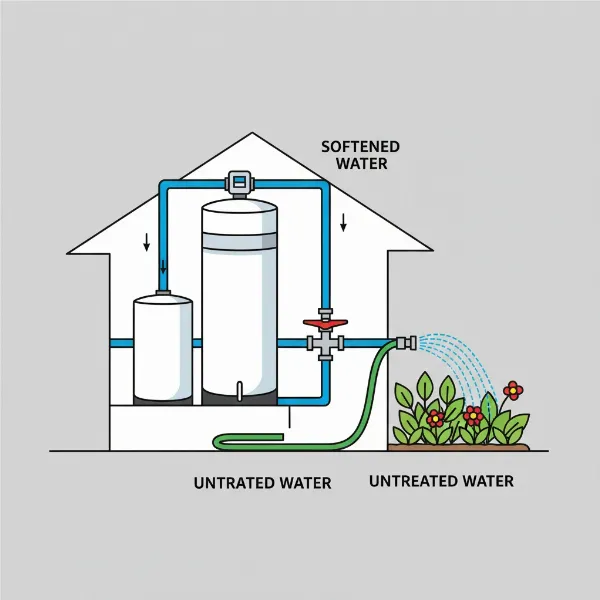
Ensuring your family has access to clean, safe drinking water is a top priority for any homeowner. Reverse osmosis (RO) systems stand out as a premier solution, capable of transforming ordinary tap water into high-quality drinking water. However, embarking on the journey to better water often leads to a fundamental choice: should you opt for a traditional tank-based RO system or a modern tankless model? Each design offers unique benefits and considerations, making the “best” choice highly personal. This comprehensive guide will dissect the pros and cons of both tank and tankless reverse osmosis systems, helping you navigate the options and select the ideal water filtration solution for your home.
Understanding Reverse Osmosis Technology
Reverse osmosis is a highly effective water purification method that removes a vast array of contaminants from water. The process works by forcing water through a semi-permeable membrane, which has microscopic pores large enough for water molecules to pass through but too small for most dissolved solids, chemicals, and microorganisms. Typically, an RO system involves several stages of filtration: pre-filters to remove larger sediments and chlorine, the RO membrane for fine purification, and post-filters to enhance taste and odor. This multi-stage approach results in water that is significantly purer than standard tap water.
The primary advantage of RO filtration lies in its ability to eliminate numerous harmful substances, including heavy metals like lead and arsenic, nitrates, sulfates, fluoride, chlorine, pesticides, bacteria, and viruses. Beyond safety, purified RO water often boasts an improved taste and odor, making it a more pleasant and convenient alternative to bottled water.
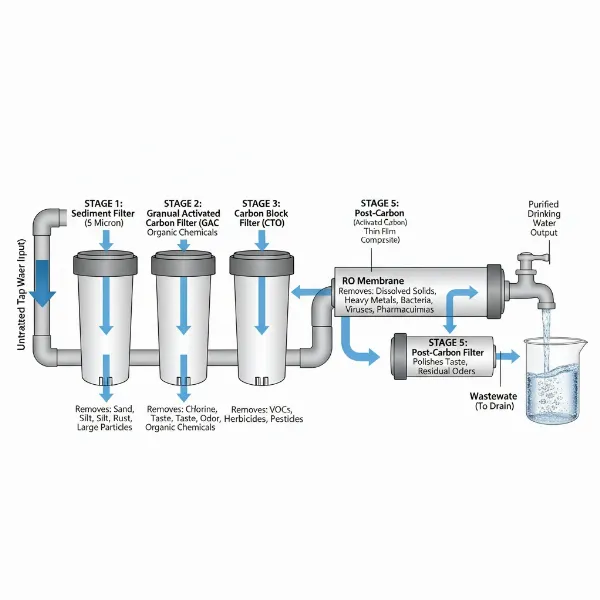 diagram showing multi-stage reverse osmosis filtration process with water flow
Tank-Based Reverse Osmosis Systems: The Traditional Choice
Tank-based reverse osmosis systems represent the traditional approach to RO water purification. These systems filter water gradually and store the purified water in a pressurized storage tank, making it readily available whenever you turn on the faucet.
Pros of Tank-Based RO Systems:
- Consistent Water Supply: One of the most significant advantages is the immediate availability of a stored reserve of purified water, providing a reliable flow on demand.
- Quiet Operation: Since the RO membrane works slowly to fill the tank, the system’s pump (if present) operates less frequently and for shorter durations, resulting in quieter overall performance.
- Well Water Suitability: Tank systems are generally more forgiving of fluctuating or lower water pressure, common in well water setups, as they don’t rely on instantaneous high flow.
- Lower Initial Cost: Typically, tank-based RO systems have a lower upfront purchase and installation cost compared to their tankless counterparts.
- Affordable Filters: Filters for tank systems are often more standardized and less expensive, contributing to lower long-term maintenance costs.
- Reliability and Longevity: With less frequent, intense operation, the components of tank systems often experience less wear and tear, potentially leading to a longer lifespan.
- Emergency Water Reserve: In the event of a power outage or temporary disruption to your water supply, a full storage tank provides a reserve of purified water.
|
Our Picks for the Best Water Filter in 2026
As an Amazon Associate I earn from qualifying purchases.
|
||
| Num | Product | Action |
|---|---|---|
| 1 | E-3000UV Whole House Salt-Free Water Softener & Filter Combo with UV |

|
| 2 | ZeroWater 32-Cup 5-Stage Water Filter Dispenser with Instant Read Out - 0 TDS for Improved Tap Water Taste - IAPMO Certified to Reduce Lead, Chromium, and PFOA/PFOS |
|
| 3 | Brita Metro Water Filter Pitcher with SmartLight Change Indicator, BPA-Free, Replaces 1,800 Plastic Water Bottles a Year, Lasts Two Months, Includes 1 Filter, Small - 6-Cup Capacity, White |
|
| 4 | ZeroWater 20-Cup Ready-Pour 5-Stage Water Filter Dispenser with 0 TDS Water Filter – IAPMO Certified to Reduce Lead, Chromium, and PFOA/PFOS |
|
| 5 | everydrop® by Whirlpool Refrigerator Water Filter A - EDRARXD1 (Pack of 1) |
|
| 6 | GLACIER FRESH Water Filter Compatible with XWFE (Built-in CHIP), Replacement for GE XWFE, XWF Refrigerator Water Filter NSF/ANSI 42 Certification Pack of 1 |
|
| 7 | FRIGIDAIRE ULTRAWF Pure Source Ultra Water Filter, Original, White, 1 Count |
|
| 8 | Brita UltraMax Large Water Dispenser With Standard Filter, BPA-Free, Reduces Copper, Cadmium and Mercury Impurities, Lasts 2 Months or 40 Gallons, Includes 1 Filter, Kitchen Accessories, Large 27-Cup |
|
| 9 | Samsung HAF-QIN/EXP Genuine Refrigerator Water Filter, Reduces 99% of Harmful Contaminants for Clean, Clear Drinking Water, 6-Month Life, Easy Install, Pack of 1 |
|
| 10 | everydrop by Whirlpool Ice and Water Refrigerator Filter 1, EDR1RXD1, Single-Pack , Purple |
|
Cons of Tank-Based RO Systems:
- Space-Consuming: The most noticeable drawback is the physical space required for the storage tank, which often takes up significant under-sink cabinet area.
- Potential for Secondary Contamination: If not properly maintained and sanitized, the storage tank can become a breeding ground for bacteria, potentially reintroducing contaminants into your purified water.
- Slower Filtration Rate: The actual filtration process to refill the tank is slow, meaning if you deplete the tank, you’ll have to wait for it to refill before getting more purified water.
- Higher Water Waste: Older tank-based RO systems typically have a higher pure-to-drain ratio, meaning they waste more water during the filtration process.
- Taste Issues: Water stored in a tank for extended periods can sometimes develop a slightly “stale” taste compared to freshly filtered water.
Tankless Reverse Osmosis Systems: The Modern Solution
Tankless reverse osmosis systems offer a contemporary alternative, designed for efficiency and convenience. These systems filter water on demand, eliminating the need for a bulky storage tank by utilizing powerful booster pumps to achieve rapid filtration rates.
Pros of Tankless RO Systems:
- Space-Saving Design: Without a large tank, tankless systems are significantly more compact, freeing up valuable under-sink space and making them ideal for smaller kitchens or apartments.
- Freshly Filtered Water: Water is filtered instantaneously as you need it, ensuring you always get the freshest possible taste without the concern of stagnation.
- Higher Water Efficiency: Modern tankless RO systems are often engineered with advanced technology to achieve a much lower pure-to-drain ratio, reducing water waste compared to traditional models.
- Faster Flow Rates: Thanks to integrated booster pumps, tankless systems typically deliver purified water at a much faster flow rate directly from the faucet.
- Reduced Contamination Risk: The absence of a storage tank virtually eliminates the risk of secondary contamination from stored water, enhancing hygiene.
- Easier Filter Changes: Many tankless designs feature quick-change filter cartridges that are simple to replace, often without the need for tools.
Cons of Tankless RO Systems:
- Higher Upfront Cost: Tankless systems, with their advanced technology and integrated pumps, generally come with a higher initial purchase and installation price.
- Requires Electricity: The booster pump integral to tankless operation requires an electrical outlet, which may not always be readily available under every sink.
- Increased Noise: The powerful booster pump, while enabling faster flow, can generate noticeable noise during operation, especially when filtering water.
- Water Pressure Dependency: These systems require consistent water pressure to function optimally; while they often include booster pumps, extremely low or fluctuating incoming pressure can still be an issue, particularly for some well water applications.
- Proprietary Filters: Filters for tankless systems are often proprietary, meaning they must be purchased from the specific manufacturer and can be more expensive.
- TDS Creep: Some tankless systems can exhibit “TDS creep,” where the initial water dispensed after a period of inactivity may have a slightly higher Total Dissolved Solids (TDS) reading before settling to optimal purity.
- Faster Wear and Tear: Due to their constant, on-demand operation, components may experience faster wear compared to systems that run intermittently.
- No Water During Outages: Without a storage tank, if there’s a power outage or municipal water supply interruption, you won’t have access to filtered water.
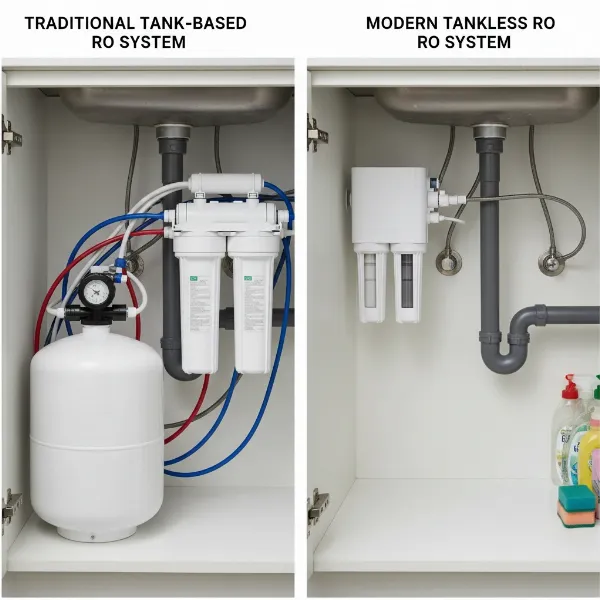 comparison image showing space difference between tank and tankless reverse osmosis systems under a kitchen sink
Head-to-Head Comparison: Tank vs. Tankless RO Systems
To simplify your decision, here’s a direct comparison of key features:
| Feature | Tank-Based RO System | Tankless RO System |
|---|---|---|
| Space Requirements | Large storage tank, takes up significant under-sink space | Compact, no tank needed, saves under-sink space |
| Water Freshness | Stored water, can be slightly stale | Freshly filtered on demand |
| Water Efficiency | Historically higher waste ratio; modern systems improving | Generally more efficient, lower waste ratio |
| Flow Rate | Fast from tank, slow refill | Fast, continuous flow on demand |
| Upfront Cost | Generally lower | Generally higher |
| Filter Cost | Standardized, often more affordable | Proprietary, typically more expensive |
| Noise Level | Quieter, pump runs less often | Can be noisier due to on-demand pump operation |
| Maintenance & Hygiene | Tank cleaning/sanitization required; risk of secondary contamination if neglected | Lower risk of secondary contamination; simpler filter changes |
| Water Pressure Suitability | More tolerant of lower/fluctuating pressure (good for well water) | Requires consistent pressure (often needs booster pump); less ideal for problematic well water |
| Power Requirement | Minimal (some models have a pump, most passive) | Requires an electrical outlet for booster pump |
| Reliability | Often longer lifespan due to less stress | May experience faster wear due to continuous operation |
Choosing the Right RO System for Your Home
Selecting between a tankless and tank RO system depends heavily on your specific needs, living situation, and priorities. Consider these factors:
- Available Space: If under-sink real estate is a luxury, a compact tankless system is undoubtedly the winner. If space is not an issue, a tank system might be perfectly suitable.
- Daily Water Consumption: For households with high, continuous demand for purified water (e.g., large families, frequent cooking), a high-capacity tankless system with a fast flow rate might be more convenient. For moderate use, a tank system often suffices.
- Source Water Quality & Pressure: If you have municipal water with good pressure, both options work well. However, if you rely on well water with variable pressure or specific heavy contamination, carefully research systems designed to handle these conditions, often leaning towards tank systems or tankless units with robust booster pumps and adequate pre-filtration.
- Budget: Evaluate not just the initial purchase price but also the long-term costs of filter replacements and potential electricity usage (for tankless systems).
- Maintenance Preferences: If you prioritize ease of maintenance and minimal risk of internal contamination, the simpler, tank-free design of a tankless system with quick-change filters may appeal to you.
- Noise Sensitivity: Consider if pump noise during water dispensing will be an issue, especially in open-plan living spaces.
- Environmental Impact: If water conservation is a key concern, look for tankless models or high-efficiency tank systems with favorable pure-to-drain ratios.
“The ideal RO system isn’t about one being inherently ‘better,’ but rather finding the perfect fit for your lifestyle, space constraints, and specific water purification needs.”
Maintenance and Longevity for Your RO System
Regardless of the type, proper maintenance is crucial for the longevity and performance of any reverse osmosis system.
For tank-based systems, regular filter replacements (pre-filters, carbon filters, and the RO membrane) are paramount, typically every 6-12 months for pre-filters and 2-3 years for the membrane. It’s also vital to sanitize the storage tank periodically to prevent bacterial growth.
For tankless systems, filter changes are often simplified with cartridge designs, but timely replacement according to the manufacturer’s schedule remains essential. Pay attention to the performance of the booster pump and check for any unusual noises or pressure drops, as these systems rely heavily on their electrical components. For both types, routine checks for leaks and ensuring proper water pressure will help prolong the life of your system and maintain water quality.
Conclusion
Choosing between a tankless and tank reverse osmosis system comes down to a careful evaluation of what truly matters for your home and lifestyle. Tank-based systems offer reliability, often at a lower initial cost, and a ready supply of water, making them a solid choice where space is abundant and consistent pressure isn’t guaranteed. On the other hand, tankless systems excel in space efficiency, deliver fresher water on demand, and boast improved water conservation, fitting perfectly into modern, compact living spaces.
Ultimately, both systems provide superior water purification, but their operational nuances cater to different preferences. By considering factors like available space, daily water needs, budget, and environmental impact, you can confidently select the RO system that best serves your pursuit of clean, safe, and great-tasting water for years to come. Which system resonates most with your vision for a healthier home?
Frequently Asked Questions
Do RO systems remove healthy minerals?
Yes, traditional reverse osmosis systems are highly effective at removing almost all dissolved solids, including beneficial minerals. Many modern RO systems, especially tankless models, offer optional remineralization filters that add a balanced blend of healthy minerals back into the water, improving taste and pH.
How much water do RO systems waste?
The amount of wastewater produced varies significantly between models. Older tank-based systems might have a 1:3 or 1:4 pure-to-drain ratio (1 gallon purified for 3-4 gallons wasted). Modern tankless systems are often more efficient, achieving ratios like 1:1 or even 2:1 (2 gallons purified for 1 gallon wasted), reducing overall water consumption.
Are RO systems difficult to install?
While some DIY-friendly RO systems exist, especially with quick-connect fittings, installation can involve plumbing connections and drilling for a dedicated faucet. If you’re not comfortable with basic plumbing, professional installation is recommended to ensure proper setup and prevent leaks.
Can RO systems be used with well water?
Yes, RO systems can be used with well water, but it’s crucial to first have your well water tested. Well water often contains high levels of sediment, hardness, iron, or bacteria, which may require additional pre-filtration stages (like a sediment filter, water softener, or UV sterilizer) before the RO system to protect the membrane and ensure optimal performance.