In an uncertain world, access to clean drinking water is not just a convenience—it’s a critical component of survival. Imagine a scenario where municipal water systems fail due to natural disasters, power outages, or other emergencies. Without a reliable source of safe water, the human body can only last a few days, making it the most immediate and vital need after air. For preppers and survivalists, understanding how to secure potable water is paramount. This comprehensive guide will navigate the complex landscape of emergency water filters, helping you select the best solutions to ensure your family’s hydration and health when it matters most.
What are Emergency Water Filters and Why You Need One?
An emergency water filter is a device designed to remove harmful contaminants from untreated water sources, making it safe for consumption. These filters become indispensable during crises when tap water becomes unavailable or unsafe. The necessity stems from the fact that natural water sources, even those appearing clear, can harbor a multitude of microscopic threats and pollutants.
Common contaminants found in water include bacteria like E. coli and Salmonella, protozoa such as Giardia and Cryptosporidium, and even viruses that can lead to severe waterborne illnesses. Beyond biological threats, water can also contain sediment, microplastics, heavy metals like lead and arsenic, and various chemicals, including chlorine byproducts and industrial pollutants. The benefits of using an emergency water filter are profound: it safeguards your health by preventing dehydration and disease, offers independence from unreliable external water supplies, and provides invaluable peace of mind during stressful times.
Types of Emergency Water Filters for Preppers
The market offers a diverse array of emergency water filters, each with unique advantages and best-use scenarios. Understanding these types is crucial for building a versatile and resilient water preparedness plan.
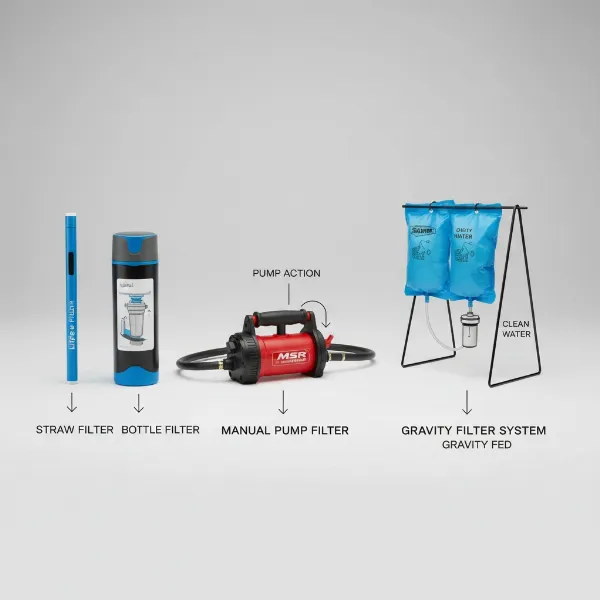 A collection of various emergency water filters including straw, bottle, pump, and gravity systems.
Straw Filters
These are among the most compact and lightweight filters, ideal for personal, on-the-go use. Popular examples include the LifeStraw and Sawyer Mini.
- Pros: Extremely portable, affordable, and allow direct drinking from a water source, making them perfect for “bug-out bags” or short excursions. Many effectively remove bacteria and protozoa.
- Cons: Primarily for individual use, don’t store filtered water, and typically do not remove viruses or chemicals. You often need to get close to the water source, which can be inconvenient.
|
Our Picks for the Best Water Filter in 2026
As an Amazon Associate I earn from qualifying purchases.
|
||
| Num | Product | Action |
|---|---|---|
| 1 | FRIGIDAIRE ULTRAWF Pure Source Ultra Water Filter, Original, White, 1 Count |

|
| 2 | Brita UltraMax Large Water Dispenser With Standard Filter, BPA-Free, Reduces Copper, Cadmium and Mercury Impurities, Lasts 2 Months or 40 Gallons, Includes 1 Filter, Kitchen Accessories, Large 27-Cup |
|
| 3 | GLACIER FRESH Water Filter Compatible with XWFE (Built-in CHIP), Replacement for GE XWFE, XWF Refrigerator Water Filter NSF/ANSI 42 Certification Pack of 1 |
|
| 4 | everydrop® by Whirlpool Refrigerator Water Filter A - EDRARXD1 (Pack of 1) |
|
| 5 | Brita Metro Water Filter Pitcher with SmartLight Change Indicator, BPA-Free, Replaces 1,800 Plastic Water Bottles a Year, Lasts Two Months, Includes 1 Filter, Small - 6-Cup Capacity, White |
|
| 6 | Samsung HAF-QIN/EXP Genuine Refrigerator Water Filter, Reduces 99% of Harmful Contaminants for Clean, Clear Drinking Water, 6-Month Life, Easy Install, Pack of 1 |
|
| 7 | ZeroWater 32-Cup 5-Stage Water Filter Dispenser with Instant Read Out - 0 TDS for Improved Tap Water Taste - IAPMO Certified to Reduce Lead, Chromium, and PFOA/PFOS |
|
| 8 | everydrop by Whirlpool Ice and Water Refrigerator Filter 1, EDR1RXD1, Single-Pack , Purple |
|
| 9 | E-3000UV Whole House Salt-Free Water Softener & Filter Combo with UV |
|
| 10 | ZeroWater 20-Cup Ready-Pour 5-Stage Water Filter Dispenser with 0 TDS Water Filter – IAPMO Certified to Reduce Lead, Chromium, and PFOA/PFOS |
|
Bottle Filters
Bottle filters integrate a filtration system directly into a water bottle, offering an all-in-one solution for personal hydration. The Grayl Ultrapress is a prime example of this type.
- Pros: Highly convenient for active individuals, provides instant filtered water, and many advanced models can remove a broader spectrum of contaminants, including viruses, bacteria, protozoa, and certain chemicals and heavy metals.
- Cons: Capacity is limited to the bottle’s volume, making them less suitable for groups or high-volume needs. They generally have a higher upfront cost compared to basic straw filters.
Pump Filters
Pump-style filters utilize a manual hand pump to force water through a filter cartridge. Products like the MSR Guardian and Sagan Life XStream are well-regarded in this category.
- Pros: Capable of filtering larger volumes of water than personal straw or bottle filters, making them suitable for small groups. They often have a faster flow rate and some models are effective against viruses and chemicals.
- Cons: Require manual effort, which can be tiring over time or in cold conditions. They may also be heavier and bulkier than individual filters.
Gravity Filters
Gravity-fed systems employ a simple yet effective principle: dirty water is placed in an upper reservoir and allowed to trickle through a filter into a clean lower container. The Sawyer Gravity Filter System, Royal Berkey, and British Berkefeld are common choices.
- Pros: Excellent for larger groups or base camps due to high capacity and hands-free operation once set up. They are often durable and can filter significant volumes of water without electricity.
- Cons: Slower filtration rates compared to pump systems, and they are generally bulkier and less portable, requiring a suitable place to hang or set up. Many primarily remove bacteria and protozoa, with some requiring additional elements for viruses or chemicals.
Ceramic Filters
Often found as components within gravity-fed or pump systems, ceramic filters use a porous ceramic material to trap impurities.
- Pros: Highly durable, can often be cleaned for extended use, and are effective at removing bacteria and protozoa.
- Cons: Tend to have slower flow rates and may not effectively remove viruses or certain chemical contaminants on their own, often requiring additional filtration stages.
Comparing Emergency Water Filter Types: A Detailed Overview
Choosing the right emergency water filter involves balancing various factors. Here’s a comparison to help you understand their trade-offs:
| Filter Type | Portability | Capacity | Contaminant Removal (Primary) | Ease of Use | Flow Rate | Best Use Case |
|---|---|---|---|---|---|---|
| Straw | Excellent (Pocket-sized, lightweight) | Personal (No storage) | Bacteria, Protozoa | Very Easy (Direct sip) | Slow | Emergency backup, solo hiking, EDC |
| Bottle | Good (Integrated bottle) | Personal (Bottle volume) | Bacteria, Protozoa, Viruses, Chemicals, Heavy Metals (model dependent) | Easy (Press/sip) | Moderate to Fast | Active individuals, travel, quick hydration |
| Pump | Moderate (Compact, but heavier) | Small Group | Bacteria, Protozoa, some Viruses/Chemicals (model dependent) | Moderate (Manual effort) | Moderate to Fast | Small groups, backpacking, diverse water sources |
| Gravity | Low (Bulky) | Large Group/Basecamp | Bacteria, Protozoa, some Chemicals/Heavy Metals (model dependent) | Easy (Hands-free once set) | Slow | Family preparedness, base camps, long-term emergencies |
| Ceramic | Varies (Component) | Varies | Bacteria, Protozoa | Moderate (Cleaning) | Slow | Integrated in larger systems, durable filtration |
Choosing the Perfect Emergency Water Filter: Key Factors to Consider
Selecting the ideal emergency water filter requires a thoughtful assessment of your specific needs and potential scenarios. There is no one-size-fits-all solution; a combination of different filter types might be the most robust approach for comprehensive preparedness.
Water Source & Contaminant Risk
The type of water you anticipate filtering significantly impacts your choice. Are you primarily concerned with clear stream water in a wilderness setting, which may contain bacteria and protozoa? Or are you preparing for urban disasters where floodwaters could introduce chemicals, heavy metals, and viruses? Identifying the most likely contaminants your water source might present will guide you toward filters with the appropriate filtration capabilities. Some filters excel at removing biological threats, while others offer broader protection against chemical pollutants.
Group Size & Capacity Needs
Consider how many people your emergency water filter needs to support and for how long. A solo prepper on a short “bug-out” trip might rely on a personal straw or bottle filter. However, a family sheltering in place or a larger group needing to filter water over an extended period will require a higher-capacity system, such as a gravity filter. Evaluate the filter’s lifespan (gallons or liters processed) and flow rate to ensure it can meet daily hydration requirements without excessive effort or wait times.
Portability vs. Stationary Use
Your movement plans dictate the filter’s form factor. For evacuation scenarios or mobile survival, lightweight, compact, and highly portable options like straw or bottle filters are crucial for your “go bag.” For static emergency preparations at home or a dedicated base camp, larger, less portable gravity-fed systems offer greater capacity and convenience without the need for constant supervision.
Filtration vs. Purification
It’s vital to understand the distinction between filtration and purification. “Filtration” typically refers to the removal of larger particles, bacteria, and protozoa through physical barriers. “Purification,” on the other hand, usually implies a more advanced process that also neutralizes or removes viruses, which are much smaller and can pass through many basic filters. For maximum safety, especially with unknown water sources, a purifier that targets all three categories—bacteria, protozoa, and viruses—is highly recommended.
Durability & Maintenance
Emergency equipment must withstand harsh conditions. Look for filters made from robust materials that can endure drops, temperature fluctuations, and repeated use. Equally important is the ease of maintenance. Can the filter be easily cleaned or backflushed in the field? Are replacement cartridges readily available and simple to install? A filter that clogs easily or is difficult to maintain can become a liability when clean water is scarce. Consider the filter’s shelf life, especially for long-term preparedness.
Budget & Certifications
While budget is always a consideration, prioritizing quality and reliability over the lowest price is critical for survival gear. Look for filters that have been tested and certified by independent organizations like NSF International (National Sanitation Foundation) or the Water Quality Association (WQA). These certifications provide assurance that a filter performs as advertised. A higher upfront cost for a certified, durable, and highly effective filter can be a worthwhile investment in your safety and health.
Top Emergency Water Filters for Survivalists
Based on effectiveness, ease of use, durability, and contaminant removal, several emergency water filters consistently stand out for preppers and survivalists.
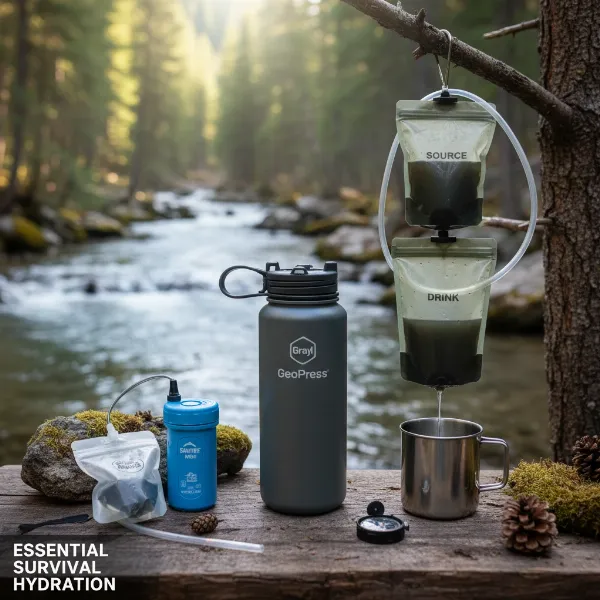 Visual representation of top-rated survival water filters like Grayl GeoPress, Sawyer Mini, and a gravity system.
Grayl GeoPress Water Purifier
The Grayl GeoPress is consistently rated as an outstanding all-in-one solution. This bottle-style purifier effectively removes viruses, bacteria, protozoa, chemicals, and heavy metals. Its press mechanism allows for rapid purification (around 10-15 seconds for 24 ounces), making it incredibly convenient for quick hydration on the move. While more expensive, its comprehensive protection and integrated design make it a top choice for individual preppers and travelers.
Sawyer Mini Water Filter
The Sawyer Mini is celebrated for its versatility, compact size, and impressive filtration capacity. This lightweight filter can be used as a straw, attached to a squeeze pouch, inline with a hydration bladder, or screwed onto a standard water bottle. It effectively removes bacteria, protozoa, and microplastics. Its small footprint and 100,000-gallon filter life make it an excellent, affordable option for individual bug-out bags or as a versatile backup filter.
Sawyer Gravity Filter System
For families or small groups, the Sawyer Gravity Filter System offers a high-volume, hands-free solution. Consisting of a dirty water bag, a filter, and a clean water bag, it uses gravity to process large quantities of water (up to one gallon) without manual pumping. It removes bacteria, protozoa, cysts, and microplastics. While its flow rate is slower than pump systems, its ease of use for bulk filtering at a base camp or campsite is a significant advantage.
LifeStraw Personal Water Filter
As one of the most recognized straw filters, the LifeStraw is an ideal budget-friendly and lightweight option for emergency kits. It allows direct drinking from contaminated sources, filtering out bacteria, protozoa, and parasites. Its simplicity and minimal weight make it an excellent personal backup, though it doesn’t filter viruses or chemicals and requires you to be near the water source.
British Berkefeld Gravity Filter
For more stationary, long-term preparedness at home or a remote cabin, the British Berkefeld gravity filter systems (similar to Royal Berkey) are robust choices. These systems typically use ceramic and carbon filtration elements that effectively remove bacteria, cysts, and a wide range of contaminants, including some chemicals and heavy metals. They offer high capacity and durability, operating without electricity, making them reliable for sustained off-grid water supply.
Using and Maintaining Your Emergency Water Filter
Proper use and diligent maintenance are critical to ensuring your emergency water filter performs effectively and lasts when you need it most.
Upon first use, always follow the manufacturer’s instructions for priming the filter. This often involves flushing it with clean water to activate the filtration media and remove any manufacturing residues. During use, always draw water from the cleanest possible source to extend filter life; pre-filtering murky water through a cloth can help remove larger sediments.
Regular cleaning is essential. Many hollow fiber filters, like the Sawyer, require backflushing with a syringe to clear trapped particles and restore flow rate. Ceramic filters, common in gravity systems, can often be gently scrubbed with a brush to remove build-up from the exterior surface. After each use, especially before storage, ensure your filter is thoroughly cleaned and dried to prevent mold or bacterial growth. Store filters in a cool, dry place, protecting them from freezing temperatures, which can damage filtration membranes. Always keep spare parts, like O-rings or replacement cartridges, on hand. Most filters have a stated lifespan in gallons or liters, so track your usage and replace cartridges according to the manufacturer’s recommendations or if you notice a significant drop in flow rate or a change in water taste.
Cost-Saving Tips for Your Water Filter Investment
Investing in emergency preparedness can add up, but there are smart ways to maximize the value of your water filter investment while ensuring safety.
Firstly, consider filters with a high overall lifespan in terms of gallons or liters. While these might have a higher upfront cost, their extended usability often translates to a lower cost per gallon over time. For instance, filters rated for tens of thousands of gallons will save money compared to those needing frequent replacement. Secondly, make regular maintenance a priority. Properly cleaning and backflushing your filter after each use, as per manufacturer guidelines, prevents premature clogging and extends the life of the filter element, delaying the need for costly replacements. Additionally, if your chosen filter uses replaceable cartridges, buying them in multi-packs or during sales can often lead to significant savings. Lastly, use filtered water wisely. While tempting to filter all water for every purpose, consider reserving filtered water for drinking and cooking, and use non-potable or less-filtered water for hygiene and other non-ingestion needs if water sources are extremely limited.
Conclusion
Securing access to clean, safe drinking water is the bedrock of any robust emergency preparedness plan. By understanding the diverse types of emergency water filters available—from portable straw filters for individual use to high-capacity gravity systems for families—and considering critical factors like contaminant removal, capacity, and durability, you can make informed decisions that safeguard your most vital resource. Proactive planning, combined with careful selection and diligent maintenance of your emergency water filters, will empower you with the resilience needed to face unforeseen challenges. Don’t wait for a crisis to realize the importance of clean water; equip yourself now. What steps will you take today to ensure your water security for tomorrow?
Frequently Asked Questions
How long can a person survive without water?
Under normal conditions, a person can typically survive for only about three days without water. This timeframe can be significantly shorter in extreme heat or with physical exertion, highlighting the critical importance of reliable emergency water sources for survival.
Can emergency water filters remove viruses?
Many basic emergency water filters primarily remove bacteria and protozoa. However, advanced water purifiers, such as those employing ultrafiltration membranes or chemical/UV treatments, are specifically designed to remove or neutralize viruses, offering a more comprehensive level of protection against waterborne pathogens.
How often should I replace my emergency water filter?
The replacement frequency for an emergency water filter depends on the manufacturer’s specifications, which typically state a maximum capacity in gallons or liters, or a recommended timeframe. Regular cleaning can extend a filter’s life, but it’s crucial to adhere to guidelines and replace filters if flow significantly decreases or water quality is suspected.
What’s the difference between water filtration and purification?
Water filtration typically involves physically removing larger particles like sediment, bacteria, and protozoa. Water purification is a more comprehensive process that, in addition to filtration, also inactivates or removes smaller contaminants, crucially including viruses and often certain chemicals or heavy metals, making the water completely safe to drink.
Are chemical purification tablets a good backup for water filters?
Chemical purification tablets, often containing iodine or chlorine dioxide, are an excellent lightweight and compact backup for emergency Water Filters. They are highly effective against bacteria, viruses, and protozoa, but they often require a waiting period and can leave an aftertaste. They are best used as a secondary method or when a filter is unavailable.