Imagine a world where clean, potable water isn’t drawn from dwindling rivers or deep underground aquifers, but harvested directly from the very air we breathe. This vision is rapidly becoming a reality thanks to Atmospheric Water Generators (AWGs), innovative devices that are redefining our approach to sustainable water solutions. With global water scarcity intensifying, understanding the potential of AWGs is crucial for securing our planet’s most vital resource.
What are Atmospheric Water Generators? Why Do We Need Them?
An Atmospheric Water Generator (AWG) is a sophisticated device that extracts water vapor from ambient air and converts it into drinkable water. This technology offers a decentralized and sustainable water source, addressing one of humanity’s most pressing challenges.
The statistics on water scarcity are alarming: approximately 770 million people worldwide lack access to clean water, and by 2025, nearly half the global population could reside in regions facing severe water shortages. Factors like climate change, rapid population growth, increased industrialization, and pollution of existing sources exacerbate this crisis. AWGs provide a crucial alternative, lessening our reliance on overstressed traditional water supplies and helping to preserve valuable natural resources. Beyond basic hydration, access to clean water impacts health, sanitation, and overall quality of life, making AWGs a vital tool in building more water-resresilient communities.
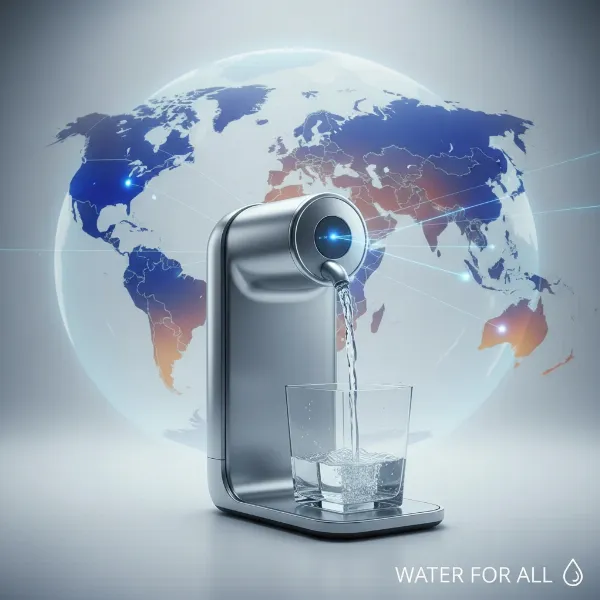 A conceptual image of an atmospheric water generator producing clean water from the air, with a global map indicating water scarcity behind it.
How Do Atmospheric Water Generators Work? The Science Behind Water From Air
The fundamental principle behind atmospheric water generation mimics nature’s own water cycle: condensation. AWGs primarily employ two methods to achieve this transformation: cooling condensation and desiccant-based systems.
The most common method, cooling condensation, functions much like a dehumidifier. Air is drawn into the unit by a fan and passed over a cooled surface, typically a coil with circulating refrigerant. As the humid air cools below its dew point, the water vapor condenses into liquid droplets. These droplets are then collected, filtered through multi-stage systems (which often include activated charcoal and UV light) to remove impurities and microorganisms, and sometimes mineralized to improve taste and nutritional value, before being stored in a reservoir for consumption. The refrigerant cycling process is optimized for efficiency, ensuring continuous water production. Desiccant-based systems, on the other hand, utilize hygroscopic materials like salts to absorb moisture from the air. Once saturated, this material is heated to release the water vapor, which is then condensed and purified in a similar manner. The effectiveness of AWGs is influenced by environmental conditions, performing optimally in warm, humid climates (typically above 60% relative humidity and 65°F or 18°C).
Exploring the Types of Atmospheric Water Generators
Atmospheric Water Generators come in a range of sizes and capacities, designed to meet diverse needs from individual households to large-scale industrial operations. Understanding these categories helps in identifying the most suitable solution for specific applications.
- Residential/Portable AWGs: These units are compact, often capable of producing 2-10 gallons (approximately 7-38 liters) of water per day. They are ideal for home use, small families, or emergency preparedness, offering water independence without complex plumbing. Their portability allows them to be moved as needed, providing flexibility.
- Medium Capacity AWGs: Producing around 20-50 gallons (approximately 75-190 liters) daily, these systems are suitable for small businesses, off-grid living, or remote locations. They often require more power but provide a substantial water supply for communal or commercial needs.
- Industrial Scale AWGs: Designed for high-volume production, these generators can produce 100+ gallons (over 380 liters) of water per day, with some systems yielding over 15,000 liters daily. They are utilized in commercial applications, community water supplies, bottling facilities, and military installations, requiring significant power (5-15 kW or more) and often integrated into existing infrastructure.
The Advantages and Disadvantages of AWG Technology
Atmospheric Water Generators represent a groundbreaking leap in addressing water scarcity, but like any technology, they come with a distinct set of pros and cons. A balanced understanding is essential for evaluating their suitability.
Advantages of Atmospheric Water Generators:
- Water Independence and Security: AWGs provide an alternative, decentralized water source, reducing reliance on municipal infrastructure, wells, or bottled water. This is invaluable during droughts, in areas with compromised water sources, or in off-grid settings.
- Sustainable Resource: By harnessing the abundant moisture in the air, AWGs do not deplete finite groundwater or surface water resources, contributing to environmental sustainability.
- High Water Purity: The water produced by AWGs, after multi-stage filtration and purification (including UV sterilization), is typically free from ground contaminants, pesticides, and heavy metals often found in traditional water sources. Many systems also re-mineralize the water for enhanced quality.
- Reduced Plastic Waste: On-demand water generation significantly reduces the need for single-use plastic bottles, aligning with global efforts to combat plastic pollution.
- Emergency Preparedness: Their ability to be deployed quickly and provide clean water makes them critical assets in natural disaster relief and emergency situations where traditional water supplies are disrupted.
- Renewable Energy Integration: Many AWG systems can be integrated with solar panels or other renewable energy sources, further lowering their environmental footprint and operational costs.
Disadvantages of Atmospheric Water Generators:
- Humidity and Temperature Dependence: AWG efficiency drops considerably in dry environments (below 50% relative humidity) or cold temperatures (below 65°F / 18°C). In such conditions, they require significantly more energy to produce water, impacting cost-effectiveness.
- Energy Consumption: Most AWGs require a notable amount of electricity to operate, particularly the cooling condensation types. This can lead to higher running costs if not powered by renewable sources, and may not be feasible in areas with unreliable electricity grids.
- Initial Investment: The upfront cost of purchasing an AWG can be substantial, especially for higher-capacity or industrial-grade units, which can be a barrier for some consumers.
- Maintenance Requirements: Regular maintenance, including filter replacement (typically every 3-6 months), cleaning of collection surfaces, and sanitization of water tanks, is crucial to prevent bacterial growth and ensure water safety and optimal performance.
- Production Capacity Limitations: While powerful, real-world water production might be lower than advertised rates, especially under suboptimal humidity conditions, which could be insufficient for very large populations or extremely high demand without multiple units.
- Space Requirements: Depending on the capacity, some AWGs can be quite large, requiring dedicated space for installation.
Applications of Atmospheric Water Generators: Where They Make a Difference
The versatility of Atmospheric Water Generators allows them to address diverse water needs across various sectors, making a tangible difference in areas grappling with water insecurity. From individual homes to remote military outposts, AWGs are carving out essential roles.
Residential and Off-Grid Living
|
Our Picks for the Best Water Filter in 2026
As an Amazon Associate I earn from qualifying purchases.
|
||
| Num | Product | Action |
|---|---|---|
| 1 | everydrop® by Whirlpool Refrigerator Water Filter A - EDRARXD1 (Pack of 1) |

|
| 2 | GLACIER FRESH Water Filter Compatible with XWFE (Built-in CHIP), Replacement for GE XWFE, XWF Refrigerator Water Filter NSF/ANSI 42 Certification Pack of 1 |
|
| 3 | Samsung HAF-QIN/EXP Genuine Refrigerator Water Filter, Reduces 99% of Harmful Contaminants for Clean, Clear Drinking Water, 6-Month Life, Easy Install, Pack of 1 |
|
| 4 | E-3000UV Whole House Salt-Free Water Softener & Filter Combo with UV |
|
| 5 | ZeroWater 20-Cup Ready-Pour 5-Stage Water Filter Dispenser with 0 TDS Water Filter – IAPMO Certified to Reduce Lead, Chromium, and PFOA/PFOS |
|
| 6 | Brita UltraMax Large Water Dispenser With Standard Filter, BPA-Free, Reduces Copper, Cadmium and Mercury Impurities, Lasts 2 Months or 40 Gallons, Includes 1 Filter, Kitchen Accessories, Large 27-Cup |
|
| 7 | Brita Metro Water Filter Pitcher with SmartLight Change Indicator, BPA-Free, Replaces 1,800 Plastic Water Bottles a Year, Lasts Two Months, Includes 1 Filter, Small - 6-Cup Capacity, White |
|
| 8 | everydrop by Whirlpool Ice and Water Refrigerator Filter 1, EDR1RXD1, Single-Pack , Purple |
|
| 9 | FRIGIDAIRE ULTRAWF Pure Source Ultra Water Filter, Original, White, 1 Count |
|
| 10 | ZeroWater 32-Cup 5-Stage Water Filter Dispenser with Instant Read Out - 0 TDS for Improved Tap Water Taste - IAPMO Certified to Reduce Lead, Chromium, and PFOA/PFOS |
|
For homeowners, particularly those in areas prone to drought or with concerns about municipal water quality, AWGs offer a reliable source of clean drinking water. They provide a sense of water independence, reducing reliance on external supplies and bottled water. In off-grid settings, where access to conventional plumbing is nonexistent or impractical, AWGs integrated with solar power offer a self-sufficient solution for daily water needs, including cooking and drinking.
Commercial and Industrial Use
Businesses are increasingly adopting AWGs for sustainable water supply. Hotels, offices, and commercial buildings can install these units to supplement their water sources, improve water quality for guests and employees, and enhance their environmental credentials by reducing plastic bottle consumption. Industrial applications are also significant, with AWGs supplying water to bottling facilities, food processing plants, and manufacturing operations, especially where high-purity water is critical and traditional sources are limited or costly.
Disaster Relief and Remote Communities
One of the most impactful applications of AWGs is in emergency response and supporting isolated populations. In the aftermath of natural disasters, when conventional water infrastructure is destroyed or contaminated, portable AWGs can be rapidly deployed to provide safe drinking water to affected communities. Similarly, remote villages or military base camps, often far from reliable water sources, benefit immensely from AWG technology, ensuring a consistent supply of potable water without the need for extensive logistical chains.
> “Atmospheric water generators are more than just a convenience; they are a critical tool for resilience, offering a lifeline in situations where traditional water sources fail.” – Dr. Anya Sharma, Environmental Engineering Specialist
The Road Ahead: Innovations and the Future of AWGs
The future of water is inextricably linked to sustainable technologies, and Atmospheric Water Generators are at the forefront of this revolution. The market for AWGs is experiencing robust growth, with projections indicating a substantial increase in value over the next decade, driven by escalating global water scarcity and continuous technological advancements.
Analysts predict the global atmospheric water generator market, valued at around USD 2.68-3.3 billion in 2023-2024, could reach USD 5.7-12.5 billion by 2030-2034, growing at a CAGR of 8% to 16% depending on the source. This growth is fueled by increasing investments in research and development aimed at enhancing efficiency, reducing costs, and expanding applicability. Innovations are focusing on improving energy efficiency, particularly for operation in lower humidity conditions, and integrating AWGs with smart technologies like IoT for remote monitoring and optimization. The development of more advanced desiccant materials and improved condensation techniques promises to make these systems even more effective. Furthermore, the push for renewable energy solutions means future AWGs will likely be increasingly powered by solar or wind energy, reducing their carbon footprint and operating expenses. As technology advances and costs decrease, atmospheric water generators are poised to become a mainstream method for water supply, especially in regions most vulnerable to climate change and water stress, playing a pivotal role in creating a water-secure future for all.
 An advanced atmospheric water generator concept integrated with solar panels and smart technology, set against a futuristic cityscape, symbolizing innovation and sustainability.
Conclusion
The escalating global water crisis demands innovative and sustainable solutions, and Atmospheric Water Generators offer a compelling answer by transforming the very air around us into potable water. These ingenious devices provide a vital path towards water independence, offering a clean, reliable, and sustainable source of drinking water for homes, industries, and communities, particularly in times of scarcity or disaster. While challenges like energy consumption and humidity dependence remain, ongoing technological advancements are continuously improving their efficiency and accessibility. As we look ahead, the integration of AWGs with renewable energy and smart systems points to a future where clean water is not a luxury, but a readily available resource for everyone, fundamentally altering our relationship with this precious element. Are you ready to embrace the innovative potential of water from air?
Frequently Asked Questions
Can Atmospheric Water Generators work in dry climates?
AWGs work most efficiently in warm, humid conditions. Their effectiveness significantly decreases in dry or cold environments, typically performing optimally above 60% relative humidity and temperatures above 65°F (18°C). While some advanced models are designed to operate in lower humidity, they often require substantially more energy.
Is the water produced by AWGs safe to drink?
Yes, the water produced by AWGs is generally safe to drink. After condensation, the collected water undergoes multi-stage filtration, often including activated carbon filters and UV sterilization, to remove dust, bacteria, and other impurities, ensuring it meets potable water standards. Many systems also re-mineralize the water.
How much water can an Atmospheric Water Generator produce?
The amount of water an AWG can produce varies significantly based on its size, technology, and environmental conditions (temperature and humidity). Residential units typically produce 2-10 gallons (7-38 liters) per day, while industrial models can generate hundreds or even thousands of gallons daily.
What are the main benefits of using an AWG?
The key benefits include providing an independent and sustainable source of clean drinking water, reducing reliance on traditional water sources, minimizing plastic waste, offering a reliable solution for emergency preparedness and remote locations, and the potential for integration with renewable energy.
What maintenance do Atmospheric Water Generators require?
Regular maintenance is essential for optimal performance and water safety. This typically includes replacing filters every 3-6 months, cleaning collection surfaces, sanitizing water storage tanks, and ensuring proper airflow through the system. Some units may require annual professional servicing.