The water flowing from your tap undergoes a rigorous treatment process to ensure its safety, and two of the most common disinfectants used are chlorine and chloramines. While essential for eliminating harmful pathogens, their presence can sometimes affect the taste, odor, and even long-term quality of your drinking water. Understanding how to accurately detect these compounds empowers you to make informed decisions about your water quality. This guide will walk you through the various methods, from simple home tests to professional analyses, ensuring you can identify chlorine and chloramines in your water and take appropriate steps.
Understanding Chlorine and Chloramines in Your Water
Water treatment facilities add disinfectants like chlorine and chloramines to eliminate harmful bacteria, viruses, and other microorganisms that can cause illness. This practice has been instrumental in eradicating waterborne diseases such as cholera and typhoid fever.
Chlorine, a highly reactive element, forms hydrochloric acid and hypochlorous acid when it reacts with water, both potent disinfectants. It works quickly but dissipates relatively fast. Chloramine, on the other hand, is a compound formed by combining chlorine with ammonia. Its key advantage is its stability and persistence, allowing it to maintain disinfection efficacy over longer distances in water distribution systems. This longevity also means it’s less prone to forming certain harmful disinfection byproducts compared to chlorine. However, chloramine can be more challenging to remove at the tap and may contribute to pipe corrosion, potentially leading to increased lead leaching from older plumbing.
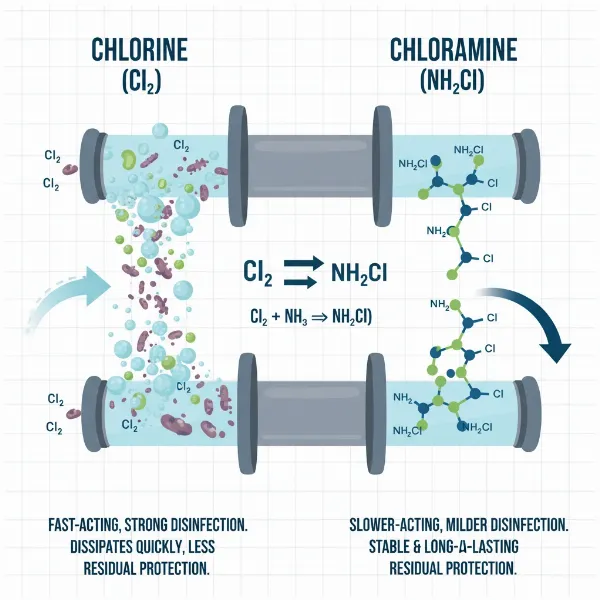 Visual representation of chlorine vs. chloramine disinfection in water treatment systems.
Detecting these disinfectants is crucial for several reasons beyond basic safety. While generally safe at regulated levels, their interaction with other substances in your water can be a concern. Chlorine imparts a distinct chemical taste and odor that many find unpleasant, while chloramine has a milder, though still noticeable, chemical residue if concentrations are high. For sensitive individuals, high levels can also irritate skin and lungs. Furthermore, chloramines are particularly toxic to aquatic life, a critical consideration for aquarium owners.
Signs Your Water Might Contain Chlorine or Chloramines
Sometimes, your senses can offer the first clues about the presence of disinfectants in your water.
Smell and Taste:
The most common indicator of chlorine in your water is a strong “bleach-like” smell and taste. This is often more noticeable with hot water, such as in a shower. Chloramine tends to have a milder, less pronounced chemical odor and taste, making it harder to identify by smell alone. If you notice an unusual chemical or swimming pool scent, it’s a good sign that disinfectants are present.
Skin and Hair Irritation:
Exposure to chlorinated water, especially in large amounts, can sometimes lead to dry skin, irritated eyes, or strip hair of its natural oils. This is because chlorine can react with the skin’s natural oils. While chloramine is generally less irritating, some individuals may still experience sensitivity.
Impact on Appliances and Plants:
Chlorine can degrade rubber and plastic components in appliances faster. For plants, both chlorine and chloramines can be detrimental, affecting their growth and health, particularly sensitive indoor plants. Aquarium owners often notice adverse effects on fish if tap water containing chloramines is added without proper treatment, as it is highly toxic to them.
Methods to Detect Chlorine and Chloramines
Fortunately, several methods are available to detect chlorine and chloramines, ranging from simple home kits to professional laboratory tests.
1. Contacting Your Water Utility
|
Our Picks for the Best Water Filter in 2026
As an Amazon Associate I earn from qualifying purchases.
|
||
| Num | Product | Action |
|---|---|---|
| 1 | Brita UltraMax Large Water Dispenser With Standard Filter, BPA-Free, Reduces Copper, Cadmium and Mercury Impurities, Lasts 2 Months or 40 Gallons, Includes 1 Filter, Kitchen Accessories, Large 27-Cup |

|
| 2 | GLACIER FRESH Water Filter Compatible with XWFE (Built-in CHIP), Replacement for GE XWFE, XWF Refrigerator Water Filter NSF/ANSI 42 Certification Pack of 1 |
|
| 3 | ZeroWater 20-Cup Ready-Pour 5-Stage Water Filter Dispenser with 0 TDS Water Filter – IAPMO Certified to Reduce Lead, Chromium, and PFOA/PFOS |
|
| 4 | E-3000UV Whole House Salt-Free Water Softener & Filter Combo with UV |
|
| 5 | everydrop® by Whirlpool Refrigerator Water Filter A - EDRARXD1 (Pack of 1) |
|
| 6 | Brita Metro Water Filter Pitcher with SmartLight Change Indicator, BPA-Free, Replaces 1,800 Plastic Water Bottles a Year, Lasts Two Months, Includes 1 Filter, Small - 6-Cup Capacity, White |
|
| 7 | Samsung HAF-QIN/EXP Genuine Refrigerator Water Filter, Reduces 99% of Harmful Contaminants for Clean, Clear Drinking Water, 6-Month Life, Easy Install, Pack of 1 |
|
| 8 | everydrop by Whirlpool Ice and Water Refrigerator Filter 1, EDR1RXD1, Single-Pack , Purple |
|
| 9 | ZeroWater 32-Cup 5-Stage Water Filter Dispenser with Instant Read Out - 0 TDS for Improved Tap Water Taste - IAPMO Certified to Reduce Lead, Chromium, and PFOA/PFOS |
|
| 10 | FRIGIDAIRE ULTRAWF Pure Source Ultra Water Filter, Original, White, 1 Count |
|
The simplest and often most reliable first step is to directly ask your local water utility. Most municipal water providers publicly state which disinfectant they use (chlorine or chloramine) in their annual Consumer Confidence Report (CCR) or on their website. A quick phone call to their customer service can also provide this information.
2. DIY Home Test Kits
For those who want to test their water at home, several convenient options are available. These kits typically measure levels in parts per million (ppm).
- Test Strips: These are perhaps the quickest, easiest, and most budget-friendly option for initial screening. You simply dip a strip into a water sample, wait a few seconds, and compare the color change to a chart provided with the kit. Many test strips measure both “free chlorine” (unbound chlorine) and “total chlorine” (the sum of free chlorine and combined chlorine, which includes chloramines). If the readings for free chlorine and total chlorine are the same, your water likely contains only chlorine. If the total chlorine reading is higher than the free chlorine reading, it indicates the presence of chloramines. While convenient for quick checks, particularly for swimming pools or hot tubs, test strips may not offer the precision required for detailed drinking water analysis.
- Liquid Drop Kits (DPD Method): Offering greater precision than test strips, liquid drop kits often utilize the N,N-diethyl-p-phenylenediamine (DPD) method. This involves adding a reagent to a water sample, which then reacts with the chlorine or chloramine to produce a pink color. The intensity of this color is directly proportional to the concentration of the disinfectant in the water, which you compare against a color chart. These kits typically provide more accurate results for determining both free and total chlorine levels, which is essential for distinguishing between chlorine and chloramines.
- Digital Colorimeters/Testers: For the most accurate home testing, digital colorimeters or testers are excellent tools. Devices like Hanna checkers provide lab-like precision with digital readouts, eliminating the subjectivity of color matching. They are capable of detecting very low concentrations, often down to 0.01 parts per million, making them ideal for those seeking highly reliable results without sending samples to a lab.
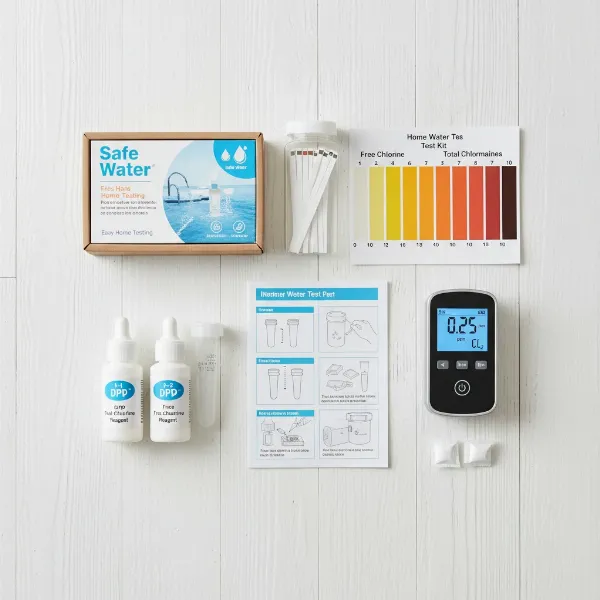 Assortment of home water test kits including strips, liquid drop kits, and a digital colorimeter.
3. Professional Laboratory Testing
While home kits provide valuable insights, certified laboratory testing is often recommended for the most comprehensive and accurate analysis of drinking water. A lab test provides more than just free or total chlorine levels; it offers crucial information on a wide array of potential contaminants, including disinfection byproducts (DBPs) and how they interact with your water’s unique chemistry. This is particularly important for understanding any potential long-term health risks or corrosive conditions that might cause pipes to leach harmful compounds.
Understanding Your Test Results
Once you’ve conducted a test, interpreting the results correctly is key.
Free Chlorine vs. Total Chlorine:
This distinction is vital for determining if chloramines are present.
- Free Chlorine refers to the active disinfectant form of chlorine (hypochlorous acid and hypochlorite) available to kill pathogens.
- Total Chlorine is the sum of free chlorine and combined chlorine (chloramines).
If your “total chlorine” reading is significantly higher than your “free chlorine” reading, it strongly suggests that your water utility uses chloramines for disinfection. If both readings are similar, it indicates the presence of primarily chlorine.
Safe Levels:
The U.S. Environmental Protection Agency (EPA) sets a maximum contaminant level goal (MCLG) for chloramines at 4 mg/L (milligrams per liter) in drinking water to protect public health. This is the same for chlorine. Most home test kits will provide readings in parts per million (ppm), which is equivalent to mg/L. Your goal should be to ensure that detected levels fall within these safe limits.
Choosing the Right Detection Method for Your Needs
The best detection method depends on your priorities:
- For quick, general checks: Test strips are ideal for daily or weekly monitoring, especially if you’re an aquarium owner needing to quickly dechloraminate water.
- For more reliable home accuracy: Liquid drop kits or digital colorimeters offer better precision for drinking water concerns.
- For comprehensive health and safety concerns: Professional lab testing provides the deepest insights into your water’s overall quality, including disinfection byproducts and other contaminants.
- For initial inquiry: Always start by contacting your local water utility.
“Understanding your water’s unique chemistry, including its disinfectant profile, is the cornerstone of ensuring safe and healthy drinking water for your family.”
Actionable Steps After Detection
Detecting chlorine or chloramines is the first step; taking action is the next.
- For Chlorine: Chlorine can often be removed by simply letting water sit for a day or two, or by boiling it for a few minutes, as it dissipates quickly. Activated carbon filters are highly effective at removing chlorine from water.
- For Chloramines: Because chloramines are more stable, they do not dissipate quickly from standing or boiling water; it can take days or even weeks. Specialized catalytic carbon filters are more effective at removing chloramines than standard activated carbon filters. If your tests show high chloramine levels, especially above the EPA’s recommended limits, consider investing in a filtration system specifically designed for chloramine reduction, such as whole-house or point-of-use filters.
- Consult Experts: If you have concerns about consistently high levels of disinfectants, or if your lab test reveals other contaminants, consult with a water quality expert or certified plumber. They can help identify the root cause and recommend tailored solutions for your home.
Conclusion
Understanding what’s in your tap water is fundamental to safeguarding your health and enhancing your quality of life. Detecting chlorine and chloramines, whether through a simple call to your water utility, a home test kit, or a comprehensive lab analysis, empowers you to take proactive measures. By identifying these common disinfectants, you can choose the right filtration methods to ensure your family enjoys clean, great-tasting, and safe water every day. What steps will you take today to ensure your water is free from unwanted chemicals?
Frequently Asked Questions
Can I just boil water to remove chloramines?
No, boiling water is generally not effective for removing chloramines. Unlike chlorine, which dissipates quickly when boiled, chloramines are much more stable and can take days or even weeks to dissipate naturally. Specialized filtration, such as catalytic carbon filters, is needed for effective chloramine removal.
Do water filters remove chloramines?
Many standard activated carbon filters are effective at removing chlorine. However, for chloramines, you need a filter specifically designed for their removal, often utilizing catalytic carbon, which is more effective at breaking down the stable chloramine bond.
What are the health effects of chloramines?
At regulated levels, chloramines are considered safe for drinking. However, some individuals may experience skin or respiratory irritation. More significantly, chloramines can react with organic matter in pipes to form disinfection byproducts, and they can also contribute to lead leaching from older plumbing, which poses health risks.
How often should I test my water for chlorine and chloramines?
If your water utility provides annual reports, reviewing those is a good start. For home testing, if you’re using a filter, testing regularly (e.g., monthly) can help ensure the filter is working effectively. If you notice changes in water taste, smell, or experience skin irritation, it’s a good idea to test more frequently.