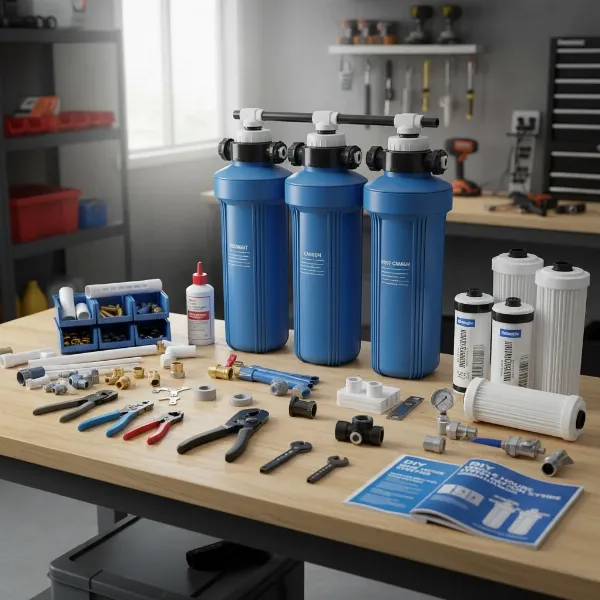
Clean water is fundamental for your household’s health and the longevity of your plumbing and appliances. Sediment, often unseen, can significantly impact water quality, leading to costly damage and reduced efficiency for your entire water system. This comprehensive guide will explore the world of sediment filters, their vital role in pre-filtration, and how to select the best one to safeguard your home’s water supply. Whether you’re battling visible particles or seeking to extend the life of your advanced filtration systems, understanding sediment filters is the first step towards achieving clearer, cleaner water throughout your home.
What is a Sediment Filter? Why Do You Need One?
A sediment filter acts as the first line of defense in water purification, specifically designed to remove physical particles from your water. These particles, known as sediment, include sand, silt, rust, dirt, and other suspended solids that can be present in both municipal and well water supplies. By physically trapping these larger impurities, sediment filters prevent them from reaching and potentially damaging downstream filtration stages or household appliances.
These contaminants, though often not harmful to consume in small quantities, can cause a range of problems. Visible debris can make water cloudy or discolored, impacting its aesthetic appeal and taste. More importantly, sediment can clog faucet aerators, reduce water pressure, and lead to premature wear and tear on washing machines, dishwashers, water heaters, and even advanced filtration systems like reverse osmosis units. Installing an effective sediment pre-filter protects these valuable investments, extends their lifespan, and ensures they operate at peak efficiency.
Common Types of Sediment Filters on the Market
Sediment filters come in various forms, each offering distinct advantages based on your specific water conditions and filtration needs. Understanding these types is crucial for making an informed choice for your home.
Spun Cartridge Sediment Filters
|
Our Picks for the Best Water Filter in 2026
As an Amazon Associate I earn from qualifying purchases.
|
||
| Num | Product | Action |
|---|---|---|
| 1 | GLACIER FRESH Water Filter Compatible with XWFE (Built-in CHIP), Replacement for GE XWFE, XWF Refrigerator Water Filter NSF/ANSI 42 Certification Pack of 1 |

|
| 2 | ZeroWater 20-Cup Ready-Pour 5-Stage Water Filter Dispenser with 0 TDS Water Filter – IAPMO Certified to Reduce Lead, Chromium, and PFOA/PFOS |
|
| 3 | FRIGIDAIRE ULTRAWF Pure Source Ultra Water Filter, Original, White, 1 Count |
|
| 4 | Samsung HAF-QIN/EXP Genuine Refrigerator Water Filter, Reduces 99% of Harmful Contaminants for Clean, Clear Drinking Water, 6-Month Life, Easy Install, Pack of 1 |
|
| 5 | Brita UltraMax Large Water Dispenser With Standard Filter, BPA-Free, Reduces Copper, Cadmium and Mercury Impurities, Lasts 2 Months or 40 Gallons, Includes 1 Filter, Kitchen Accessories, Large 27-Cup |
|
| 6 | everydrop® by Whirlpool Refrigerator Water Filter A - EDRARXD1 (Pack of 1) |
|
| 7 | ZeroWater 32-Cup 5-Stage Water Filter Dispenser with Instant Read Out - 0 TDS for Improved Tap Water Taste - IAPMO Certified to Reduce Lead, Chromium, and PFOA/PFOS |
|
| 8 | Brita Metro Water Filter Pitcher with SmartLight Change Indicator, BPA-Free, Replaces 1,800 Plastic Water Bottles a Year, Lasts Two Months, Includes 1 Filter, Small - 6-Cup Capacity, White |
|
| 9 | everydrop by Whirlpool Ice and Water Refrigerator Filter 1, EDR1RXD1, Single-Pack , Purple |
|
| 10 | E-3000UV Whole House Salt-Free Water Softener & Filter Combo with UV |
|
Spun cartridges, often made from polypropylene, are depth filters that trap sediment within their layers of tightly packed fibers. These filters are highly effective for situations with high dirt loads, offering reliable and cost-effective filtration. They are disposable and need regular replacement.
Pleated Sediment Filters
Pleated filters feature a pleated fabric or mesh design that significantly increases the surface area for particle capture. This design allows for a higher flow rate and greater dirt-holding capacity compared to spun cartridges. Many pleated filters are also washable and reusable, making them a more economical choice over time for moderate sediment levels.
String-Wound Sediment Filters
String-wound filters are depth filters constructed from a tightly wound string around a central core. They excel in high-pressure systems and provide excellent sediment removal by trapping particles at various depths within the winding. Their robust construction allows them to handle heavy sediment loads effectively.
Spin-Down Sediment Filters
Spin-down filters utilize centrifugal force to separate larger sediment particles from water. As water enters the filter, it spins, forcing heavier particles to the bottom of a collection bowl, which can then be flushed out. These reusable filters are ideal for well water with significant amounts of large sediment, requiring minimal maintenance.
Dual Gradient Sediment Filters
Some advanced sediment filters, known as dual gradient filters, combine different micron ratings within a single cartridge. For example, a 50 to 5-micron filter might have a coarser 50-micron outer layer to capture larger particles and a finer 5-micron inner layer for smaller sediment. This multi-stage approach extends filter life and improves overall filtration efficiency.
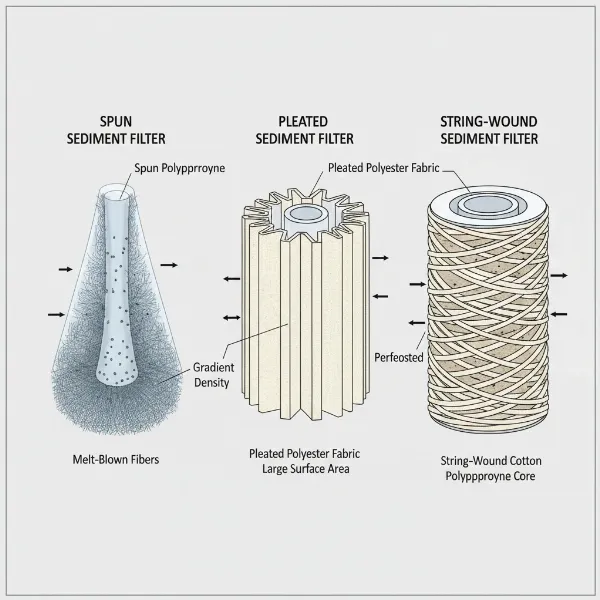 An illustrative diagram showing different types of sediment filters like spun, pleated, and string-wound, highlighting their internal structures.
Comparing Popular Sediment Filter Types: A Detailed Table
Choosing the right sediment filter involves weighing various factors, including filtration effectiveness, maintenance, cost, and typical applications. The following table provides a clear comparison of the most common types:
| Filter Type | Filtration Mechanism | Reusability | Ideal for | Pros | Cons |
|---|---|---|---|---|---|
| Spun Cartridge | Depth filtration (polypropylene) | No | High dirt loads, general pre-filtration | Cost-effective, good dirt-holding | Disposable, requires frequent replacement |
| Pleated | Surface filtration (pleated fabric) | Yes | Moderate sediment, extends filter life | Higher flow rate, reusable, larger surface area | Higher initial cost than spun, not for extremely fine sediment |
| String-Wound | Depth filtration (wound string) | No | High pressure, varying particle sizes | Excellent for heavy sediment, robust, depth filtration | Disposable, can restrict flow if micron rating is too fine |
| Spin-Down | Centrifugal force | Yes | Heavy, coarse sediment (well water) | Reusable, easy to clean, good for large particles | Limited for very fine sediment, higher initial cost |
| Dual Gradient | Multi-layer depth filtration | No | Broad range of sediment, extended life | Captures various particle sizes, longer lifespan | Disposable, can be more expensive than single-micron filters |
How to Choose the Perfect Sediment Filter for Your Home
Selecting the ideal sediment filter requires a thoughtful evaluation of your specific water conditions and household needs. There are several key factors to consider to ensure you choose a filter that provides effective protection without compromising water flow.
Source Water Assessment
First, identify your water source. Well water often contains a higher concentration of larger sediment particles like sand, silt, and rust, requiring a robust filter. Municipal city water, while generally cleaner, can still carry fine sediment from aging pipes or water treatment processes. Conducting a water quality test is the most reliable way to pinpoint the exact types and levels of contaminants present in your water. This test will guide you in determining the appropriate micron rating for your filter.
Household Usage and Flow Rate
Consider the number of people in your household and your average daily water consumption. A larger family or a home with multiple bathrooms will demand a higher flow rate to maintain consistent water pressure throughout the house. Ensure the filter’s flow rate (measured in gallons per minute, or GPM) matches or exceeds your home’s peak demand to avoid pressure drops. Larger filter housings, such as 10-inch or 20-inch “Big Blue” systems, are often recommended for high-usage households.
Micron Rating Selection
The micron rating indicates the smallest particle size a filter can capture. For context, a human hair is about 70 microns thick, while fine sand is approximately 90 microns.
- 50-20 microns: Good for larger particles like coarse sand and rust flakes, often used as a first stage in multi-stage systems or for very heavy sediment loads.
- 10-5 microns: Ideal for removing finer sediment like silt and dirt, commonly used as a general pre-filter for whole-house systems and to protect UV disinfection units. A 5-micron filter offers a good balance between clarity and flow for many homes.
- 1 micron: Designed for ultra-fine particles, providing superior clarity. However, 1-micron filters can clog more quickly and may lead to noticeable pressure drops if the sediment load is high.
It is often beneficial to use a staged filtration approach, starting with a coarser filter (e.g., 50 or 20 micron) to remove larger particles, followed by a finer filter (e.g., 5 or 1 micron) for comprehensive sediment removal.
Budget and Maintenance
Evaluate your budget for both the initial purchase and ongoing maintenance, including replacement cartridges. While some reusable pleated and spin-down filters have a higher upfront cost, they can offer long-term savings. Disposable cartridges, while less expensive individually, accrue costs over time. Consider the lifespan of cartridges (typically 3-9 months depending on water quality) and the ease of replacement when making your decision.
Brand Reputation and Certifications
Opt for reputable brands known for quality and reliability. Look for certifications from organizations like NSF International (National Sanitation Foundation) or the WQA (Water Quality Association). These certifications ensure that the product meets stringent public health standards for performance and safety, giving you peace of mind regarding your investment.
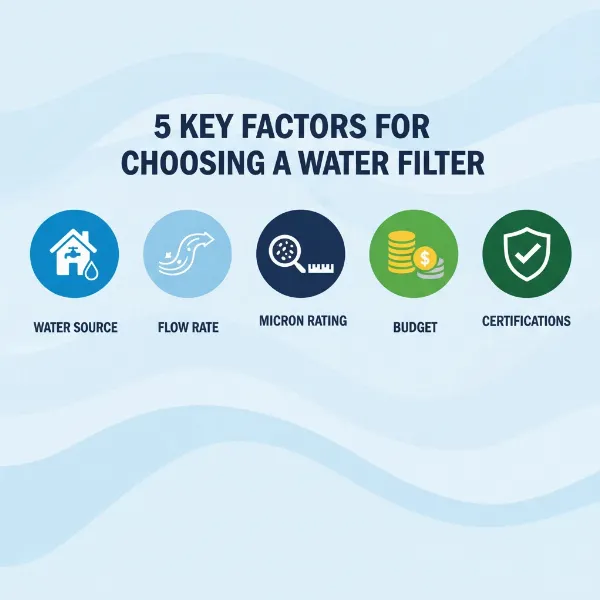 An infographic illustrating key factors to consider when choosing a sediment filter: water source, flow rate, micron rating, budget, and certifications.
Top-Rated Sediment Filters for Whole-House Pre-Filtration
Choosing the right sediment filter can feel overwhelming with the many options available. Here are some of the top-rated sediment filters often praised for their performance and reliability in whole-house pre-filtration systems. These examples represent various types and cater to different needs and budgets.
-
iSpring WSP-50 Reusable Spin-Down Sediment Filter:
- Pros: This spin-down filter is lauded for its reusability, making it an economical choice for well water with heavy sediment. It’s designed to capture larger particles (40-200 micron rating) and can be easily flushed for cleaning, extending the life of downstream filters. Its robust construction ensures durability.
- Cons: Primarily handles larger sediment; may need a finer filter afterward for very small particles. Higher initial cost than disposable cartridges.
- Ideal For: Homes with well water experiencing significant amounts of sand, rust, or other coarse debris.
-
Pentair Whole House Sediment Prefilter System:
- Pros: Pentair systems are known for their reliability and effectiveness, often featuring cartridge-based filtration. They effectively reduce sediment down to 5 microns, protecting appliances and improving overall water quality. Cartridges typically last up to 9 months, depending on usage.
- Cons: Cartridge replacement can be a recurring cost.
- Ideal For: Both city and well water applications where effective 5-micron sediment removal is needed before other filtration stages.
-
Culligan WH-HD200-C Heavy Duty Whole House Filter:
- Pros: This heavy-duty system is a popular choice for its robust performance and value. It accommodates various cartridge types, including pleated and spun sediment filters, allowing for flexibility in micron rating (e.g., 5 or 20 micron). It’s designed for high flow rates, suitable for larger homes.
- Cons: Cartridges need regular replacement.
- Ideal For: Homeowners seeking a versatile and durable whole-house system that can be adapted to specific sediment challenges.
-
SimPure Whole House Sediment Filters:
- Pros: SimPure offers multi-stage whole-house systems that often include a high-capacity sediment pre-filter. Their filters are effective for reducing a wide range of sediments and are designed to extend the life of subsequent carbon filters. Some models feature reusable elements.
- Cons: Specific models vary in features and costs.
- Ideal For: Those looking for integrated whole-house solutions where sediment reduction is a critical first step, especially for well water applications.
It’s always recommended to consult your water test results and consider your home’s specific flow requirements when choosing among these top options.
Using and Maintaining Your Sediment Filter for Optimal Performance
Proper installation, regular maintenance, and timely replacement are critical to ensuring your sediment filter functions effectively and provides long-lasting protection for your home’s water system. Neglecting these steps can lead to reduced filtration efficiency, decreased water pressure, and even damage to other appliances.
Installation Guidelines
Most whole-house sediment filters are installed at the main water line where water enters your home, also known as the point-of-entry. This ensures all water is treated before reaching any faucets or appliances. It is often recommended to install a bypass valve around the filter housing, allowing you to easily perform maintenance or cartridge changes without interrupting your home’s entire water supply. Always follow the manufacturer’s specific instructions for installation, including proper sealing techniques and checking for leaks.
Regular Cleaning and Cartridge Replacement
The frequency of cleaning or cartridge replacement depends heavily on your water quality and household water usage. In general, disposable sediment filter cartridges should be replaced every three to nine months. However, if you notice a significant drop in water pressure or observe visibly cloudy water despite having a filter, it’s a strong indicator that the filter is clogged and needs immediate attention.
For reusable pleated or spin-down filters, routine cleaning is essential. Spin-down filters typically have a flush valve that allows you to easily drain accumulated sediment. Pleated filters can often be removed and rinsed with a hose to clear trapped particles, restoring some of their filtration capacity. Always refer to your filter’s manual for precise cleaning instructions to avoid damaging the filter media.
Important Tips for Longevity
To maximize the lifespan and efficiency of your sediment filter and overall water system, consider these crucial tips:
- Monitor Water Pressure: A consistent drop in water pressure is the most common sign that your sediment filter is nearing the end of its life or is severely clogged.
- Test Your Water Periodically: Even after initial testing, re-testing your water every year or two can help you adjust your filtration strategy as water conditions may change.
- Use Genuine Replacement Parts: Always use original or manufacturer-approved replacement cartridges to ensure compatibility and maintain the performance standards of your system.
- Consider Staged Filtration: If you have very high sediment levels, implementing a multi-stage sediment filtration system—starting with a coarser filter and progressing to finer ones—can significantly extend the life of each individual cartridge and improve overall filtration.
“Proactive maintenance of your sediment filter is not just about changing a cartridge; it’s about safeguarding your entire plumbing infrastructure and ensuring the continuous quality of your home’s water.” – John Smith, Senior Water Filtration Technician
Smart Tips to Save Money on Sediment Filter Usage
Investing in a sediment filter is a wise decision for water quality and appliance protection, but there are smart strategies to manage ongoing costs effectively. By implementing a few simple practices, you can reduce expenditures while maintaining excellent water filtration performance.
One key approach is to select sediment filters with a longer lifespan or those designed for reusability. For instance, pleated sediment filters, which can often be cleaned and reused multiple times, offer a better return on investment over disposable spun cartridges, especially if your water has moderate sediment levels. Similarly, spin-down filters, which allow for easy flushing of accumulated debris, drastically reduce the need for frequent cartridge replacements.
Regular cleaning of reusable filter elements is another crucial cost-saving measure. By rinsing pleated filters or flushing spin-down systems as recommended by the manufacturer, you can extend their effective service life. This simple habit prevents premature clogging and delays the need for new cartridges.
Furthermore, consider purchasing genuine replacement cartridges in multi-packs or during sales events to take advantage of bulk discounts. While it’s vital to use high-quality, manufacturer-recommended replacements to maintain performance, buying them strategically can lead to significant savings over time. Avoid generic cartridges that might compromise filtration quality or fit.
Lastly, optimizing your overall water usage can indirectly contribute to savings. Using water responsibly helps prolong the life of your filters by reducing the volume of water processed, thus slowing down sediment accumulation. Ultimately, a well-maintained sediment filter ensures your more expensive downstream filters (like carbon blocks or RO membranes) last longer, saving you money across your entire water treatment system.
Conclusion
Sediment filters are an indispensable component of any effective home water treatment strategy, acting as the critical first step in protecting your water supply and household investments. By efficiently removing undesirable particles like sand, silt, and rust, these filters ensure clearer water, preserve water pressure, and significantly extend the lifespan of your plumbing and more advanced filtration systems. From understanding the diverse types available—such as spun, pleated, and spin-down filters—to carefully considering micron ratings, flow rates, and maintenance requirements, making an informed choice is paramount.
Prioritizing a high-quality sediment filter for pre-filtration safeguards against common water issues, preventing premature wear and tear on appliances and reducing the frequency of costly repairs. Remember to assess your water source, match the filter to your household’s demands, and adhere to a consistent maintenance schedule to maximize performance and longevity. Investing in the best sediment filters for your home is not just about clean water; it’s about investing in the health and efficiency of your entire household. What steps will you take today to ensure your water is free from sediment?
Frequently Asked Questions
Is a 1 micron or 5 micron sediment filter better for general household use?
The “better” choice depends on your specific needs. A 1-micron filter captures finer particles for superior clarity but can clog faster and potentially reduce water pressure. A 5-micron filter offers a good balance, effectively removing most common sediment while maintaining better flow and typically requiring less frequent replacement for average households.
How often should I replace my sediment filter cartridge?
Most disposable sediment filter cartridges should be replaced every three to nine months. However, the exact frequency varies based on your water’s sediment load and household water usage. A noticeable drop in water pressure or visibly cloudy water are key indicators that it’s time for a replacement.
Can a sediment filter remove dissolved contaminants?
No, sediment filters are designed to remove physical particles like sand, silt, and rust. They are not effective at removing dissolved contaminants such as chlorine, heavy metals, bacteria, or chemicals. For these impurities, you would need additional filtration stages like carbon filters, reverse osmosis, or UV purifiers.
What is the advantage of a spin-down sediment filter?
Spin-down sediment filters are advantageous for homes with very high levels of coarse sediment, especially well water users. They use centrifugal force to separate larger particles, which collect in a flushable bowl. This reusability reduces the need for frequent cartridge replacements, offering convenience and long-term cost savings.
Do I need a sediment filter if I already have a whole-house water filter system?
Yes, a sediment filter is almost always recommended as the first stage in any multi-stage whole-house water filtration system. It acts as a pre-filter, removing larger particles that could otherwise clog and reduce the efficiency or lifespan of subsequent, more expensive filters like carbon blocks or RO membranes.