As an expert with over a decade in water filtration, I understand that while choosing the right filter ensures clean water, knowing how to properly dispose of expired water filter cartridges is equally crucial. Many people simply toss their used filters in the bin, unaware of the environmental implications and the potential for responsible recycling. This guide will walk you through the best practices for disposing of your old water filters, from understanding their components to exploring dedicated recycling programs, ensuring your efforts for cleaner water extend to a cleaner planet.
Understanding Your Water Filter Cartridges
|
Our Picks for the Best Water Filter in 2026
As an Amazon Associate I earn from qualifying purchases.
|
||
| Num | Product | Action |
|---|---|---|
| 1 | Samsung HAF-QIN/EXP Genuine Refrigerator Water Filter, Reduces 99% of Harmful Contaminants for Clean, Clear Drinking Water, 6-Month Life, Easy Install, Pack of 1 |

|
| 2 | Brita UltraMax Large Water Dispenser With Standard Filter, BPA-Free, Reduces Copper, Cadmium and Mercury Impurities, Lasts 2 Months or 40 Gallons, Includes 1 Filter, Kitchen Accessories, Large 27-Cup |
|
| 3 | FRIGIDAIRE ULTRAWF Pure Source Ultra Water Filter, Original, White, 1 Count |
|
| 4 | everydrop by Whirlpool Ice and Water Refrigerator Filter 1, EDR1RXD1, Single-Pack , Purple |
|
| 5 | ZeroWater 20-Cup Ready-Pour 5-Stage Water Filter Dispenser with 0 TDS Water Filter – IAPMO Certified to Reduce Lead, Chromium, and PFOA/PFOS |
|
| 6 | E-3000UV Whole House Salt-Free Water Softener & Filter Combo with UV |
|
| 7 | everydrop® by Whirlpool Refrigerator Water Filter A - EDRARXD1 (Pack of 1) |
|
| 8 | ZeroWater 32-Cup 5-Stage Water Filter Dispenser with Instant Read Out - 0 TDS for Improved Tap Water Taste - IAPMO Certified to Reduce Lead, Chromium, and PFOA/PFOS |
|
| 9 | Brita Metro Water Filter Pitcher with SmartLight Change Indicator, BPA-Free, Replaces 1,800 Plastic Water Bottles a Year, Lasts Two Months, Includes 1 Filter, Small - 6-Cup Capacity, White |
|
| 10 | GLACIER FRESH Water Filter Compatible with XWFE (Built-in CHIP), Replacement for GE XWFE, XWF Refrigerator Water Filter NSF/ANSI 42 Certification Pack of 1 |
|
Water filter cartridges are sophisticated devices designed to remove impurities, but their composite nature often makes disposal complex. Generally, these cartridges consist of a plastic casing, which might be made from polypropylene (PP) or high-density polyethylene (HDPE), and internal filtration media. The media can vary widely, including activated carbon, which excels at removing chlorine and organic compounds; ion exchange resins for softening water; pleated synthetic fibers for sediment removal; or even reverse osmosis (RO) membranes for advanced purification. [cite: 1, 2, 3, 4, 5 (materials breakdown search results)] Some filters might also contain small amounts of silver as an antimicrobial agent. [cite: 4 (are water filter cartridges hazardous waste search results)]
Understanding these components is key because the mix of plastics, carbons, and resins means that traditional curbside recycling programs often cannot process them efficiently. Improper disposal can lead to these materials accumulating in landfills, where plastics can take hundreds of years to decompose. Even the filtration media, while generally benign when used for potable water, could contain trapped contaminants if simply discarded without proper consideration.
Is Your Used Water Filter Cartridge Hazardous Waste?
For the vast majority of household water filters used for potable (drinking) water, the expired cartridge is generally not considered hazardous waste. [cite: 1 (are water filter cartridges hazardous waste search results)] Once the filter has captured contaminants from your tap water, its internal components, primarily activated carbon and various plastics, become inert. Therefore, in most cases, a used water filter cartridge can be safely placed in your regular household trash. [cite: 1, 3 (are water filter cartridges hazardous waste search results)]
However, there’s a significant caveat: you should never attempt to cut open or disassemble a used water filter cartridge yourself. [cite: 5 (are water filter cartridges hazardous waste search results)] The contaminants trapped inside the filter, though no longer in your drinking water, are still present within the media. Opening the cartridge can expose you and the environment to these collected impurities, negating your efforts for clean water and safe disposal. While some advanced systems like whole-house filters or reverse osmosis membranes might have components that local regulations could classify differently, for standard pitcher, faucet, or refrigerator filters, they are typically considered non-hazardous domestic waste. Always check with your local waste management facility for specific guidelines, especially for larger or industrial-grade filters.
“Many people are surprised to learn that their standard household water filter cartridges aren’t usually hazardous waste, but it’s crucial not to open them. Those trapped contaminants are exactly where they should be – safely contained within the filter.”
Manufacturer Recycling Programs: A Convenient Option
The most environmentally friendly and often easiest method for disposing of used water filter cartridges is to utilize manufacturer-specific recycling programs. Several leading brands have taken the initiative to offer dedicated schemes, partnering with recycling specialists to ensure their products are processed responsibly.
Brita Recycling Program
Brita, a popular name in water filtration, has partnered with TerraCycle to offer a comprehensive recycling program. This initiative allows consumers to recycle a wide range of Brita products, including pitchers, dispensers, bottles, faucet systems, filters, and even filter packaging. [cite: 3 (Brita water filter recycling program search results)]
How it works:
- Collect: Create an account with TerraCycle and begin collecting your used Brita products and packaging in any cardboard box. [cite: 3 (Brita water filter recycling program search results)]
- Prepare: Ensure filters are dry before shipping to prevent mold or odors.
- Ship: Once your box is full, download and print a free, prepaid shipping label from your TerraCycle account. Affix the label to your sealed box and send it off. [cite: 2, 3 (Brita water filter recycling program search results)]
- Earn Rewards: For every shipment, you can earn TerraCycle points that can be redeemed as donations to a school, charity, or nonprofit organization of your choice. [cite: 2, 5 (Brita water filter recycling program search results)]
It’s worth noting that due to the program’s success, there might occasionally be a waitlist to send in items. [cite: 2 (Brita water filter recycling program search results)]
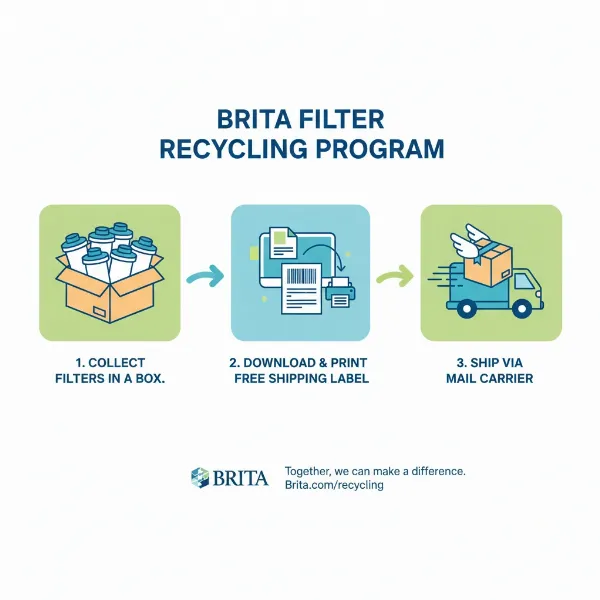 A graphic illustrating the Brita water filter recycling process with TerraCycle, showing collection, labeling, and shipping.
ZeroWater Recycling Program
ZeroWater also offers a recycling program, encouraging customers to reduce their carbon footprint by returning their used filters.
How it works:
- Collect: Gather your used ZeroWater filters. Some programs require a minimum quantity (e.g., at least 2 or 10 filters) for return. [cite: 1, 2 (ZeroWater filter recycling program search results)]
- Prepare: Ensure filters are empty and dry.
- Ship: Fill out a recycling form (often available on their website) and send your filters to their recycling center. While some programs previously offered free shipping labels, current information suggests customers might need to cover shipping costs or add a recycling bag to an order. [cite: 1, 2, 5 (ZeroWater filter recycling program search results)]
- Receive a Coupon: As an incentive, ZeroWater often provides a coupon code or voucher for future purchases upon receiving your recycled filters. [cite: 1, 5 (ZeroWater filter recycling program search results)]
ZeroWater filters are typically marked with recycling code #5 (polypropylene), and the company strives to reuse as many filter materials as possible. [cite: 2 (ZeroWater filter recycling program search results)]
Other Manufacturers
Many other water filter brands, such as Everpure and PUR, also have their own recycling initiatives or partnerships. [cite: 4 (Recycling Water Filters search results), 5 (How to Dispose Water Filter search results)] To find specific instructions for your brand, it’s always best to:
- Check the manufacturer’s website: Look for “Recycling,” “Sustainability,” or “Disposal” sections.
- Contact customer support: If information isn’t readily available, their customer service can provide guidance or direct you to a suitable program.
- Look for recycling symbols: Some cartridges have plastic identification codes (e.g., #5 PP) on their casings, which might indicate local recycling possibilities if the internal media is separated (though this is not recommended for consumers). [cite: 3 (America Recycles Day Water Filter Recycling Tips search results), 4 (Recycling Water Filters search results)]
Local Recycling and Waste Management
While manufacturer programs are ideal, they might not always be an option, or you might have a brand without a dedicated program. In such cases, local recycling facilities and waste management services are your next point of contact. However, it’s essential to understand that water filters are often considered “hard-to-recycle items” by many municipal programs. [cite: 2 (Recycling Mystery: Water Filters search results)]
Why traditional curbside recycling is often not an option:
The main challenge lies in the composite nature of water filter cartridges. They typically contain a mix of different plastics, activated carbon, and other filtration media bonded together. Standard recycling machinery struggles to separate these diverse materials, making it uneconomical and inefficient for curbside programs to process them. [cite: 2 (America Recycles Day Water Filter Recycling Tips search results)]
How to check with local centers:
- Call your local recycling center: Before heading out, contact your local recycling facility, waste management department, or department of public works. Ask if they accept water filter cartridges and, if so, what preparation is needed. Policies can change frequently, so a quick call is always a good idea. [cite: 2 (Recycling Mystery: Water Filters search results)]
- Use recycling databases: Resources like Earth911 provide an online recycling database where you can type in “water filters” and your ZIP code to find local facilities that might accept them. [cite: 2 (Recycling Mystery: Water Filters search results)]
- Inquire about plastic types: If your filter manufacturer doesn’t have a recycling program, you can ask them about the specific plastic type used in the filter shell, often indicated by a number surrounded by three arrows. With this information, your local recycler might be able to advise if they accept that specific plastic type (e.g., #5 polypropylene) if the internal components can be removed. [cite: 3 (America Recycles Day Water Filter Recycling Tips search results)] Again, remember that disassembling the filter yourself is generally not recommended due to exposure to trapped contaminants. [cite: 5 (are water filter cartridges hazardous waste search results)]
In situations where local facilities cannot process whole cartridges, they may provide guidance on safe disposal as general waste.
General Household Waste: When All Else Fails
If manufacturer recycling programs are unavailable and local recycling centers do not accept water filter cartridges, placing them in your general household waste for landfill is typically the last resort. For filters used exclusively with potable water, this is generally considered a safe method of disposal. [cite: 1 (are water filter cartridges hazardous waste search results)]
How to prepare for trash:
- Drain and dry: Allow the used filter to fully drain and dry for a few days. This prevents excess water from adding weight to waste and discourages mold growth.
- Seal: For added precaution and to prevent any residual drips or odors, you can place the dried filter cartridge in a sealed plastic bag before discarding it in your trash bin.
- Do NOT pour media down the drain: Never attempt to rinse or pour any internal filter media (like activated carbon beads or resins) down your sink or toilet. Your plumbing and local water systems are not designed to handle these materials, and it can introduce trapped contaminants back into the environment. [cite: 3 (are water filter cartridges hazardous waste search results)]
While sending filters to a landfill is not ideal from an environmental perspective, it is a responsible alternative when recycling options are exhausted, provided the filter was used for its intended purpose with potable water.
Tips for Eco-Conscious Consumers
For those committed to minimizing their environmental footprint, there are several proactive steps you can take regarding your water filtration choices:
- Choose brands with robust recycling programs: When purchasing a new water filtration system, prioritize manufacturers that actively offer take-back or recycling programs for their used cartridges. This makes responsible disposal much simpler down the line.
- Consider reusable or refillable filters: Some systems feature reusable housings with replaceable media (e.g., loose activated carbon, ceramic elements that can be cleaned). While initial setup might be different, these can significantly reduce plastic waste over time.
- Research before you buy: Look into the disposal options for a filter before you commit to purchasing it. A little foresight can save a lot of headaches later.
- Support advocacy: Encourage local recycling initiatives to expand their acceptance of complex items like water filters. Consumer demand can drive change in waste management practices.
Conclusion
Disposing of expired water filter cartridges doesn’t have to be a confusing or wasteful process. By understanding the components of your filters and knowing the available options, you can make informed decisions that benefit both your home and the environment. Always start by checking if your filter’s manufacturer offers a recycling program, as this is often the most straightforward and eco-friendly solution. If not, consult your local recycling facilities for any specific guidelines. As a last resort, properly preparing and discarding filters in general household waste is acceptable for those used with potable water. Every small effort contributes to a larger impact, transforming what might seem like a mundane chore into a meaningful step towards a more sustainable future.
What steps will you take to ensure your next expired water filter cartridge finds its way to a responsible end?
Frequently Asked Questions
Can I put water filter cartridges in my regular recycling bin?
Generally, no. Most curbside recycling programs cannot process water filter cartridges due to their composite nature, which includes a mix of plastics and filtration media that are difficult to separate. Always check with your local facility or the manufacturer first.
How do I know if my water filter brand has a recycling program?
The best way is to visit the manufacturer’s official website and look for sections on “Recycling,” “Sustainability,” or “Disposal.” Alternatively, contact their customer service directly for information on any take-back or mail-in recycling programs they may offer.
Are all types of water filters recyclable through special programs?
While many popular brands like Brita and ZeroWater have established recycling programs, not all types or brands of water filters are covered. Large whole-house filters, specialized industrial filters, or less common brands may require different disposal methods.
What should I do before sending my filter for recycling or disposing of it?
For both recycling and general waste disposal, it’s recommended to allow the used filter cartridge to drain and dry completely for a few days. This prevents excess moisture, potential odors, and can be a requirement for mail-back programs. Do not open or disassemble the filter.
Is it safe to put water filter media down the drain?
No, you should never pour or flush Water Filter media (such as activated carbon or ion exchange resins) down the drain or toilet. These materials can clog plumbing and introduce trapped contaminants into the wastewater system, which is not designed to handle them.