Let’s be honest, we all want to trust the water that comes out of our taps. But have you ever stopped to wonder what’s really in that glass of H2O? The truth can be a little unsettling. That’s where water filters come in, but not all filters are created equal. You’ve probably heard of a dozen different types, but today we’re diving deep into a game-changer. So, What Is Selective Filtration Technology? In short, it’s the intelligent approach to water purification that might just be the perfect solution for your home and family.
It’s a common worry I hear from people all the time: “I want to filter out the bad stuff, but am I also removing things my body needs?” It’s a fantastic question. Many of us are trying to get more essential minerals like calcium and magnesium, not less. This is precisely the problem that older filtration methods couldn’t solve, and it’s where this smarter technology shines.
The Water Filtration Dilemma: Good vs. Bad
Before we unpack the “how,” let’s talk about the “why.” Your tap water isn’t just pure H2O. It’s a complex cocktail of various substances. Some are harmless, some are even beneficial, and some… well, you’d rather not drink them.
- The Unwanted Guests: These are the contaminants we’re all trying to avoid. They can sneak into water supplies from old pipes, industrial runoff, or even the treatment process itself. This list includes:
- Heavy Metals: Think lead from aging plumbing or mercury from industrial pollution.
- Chemicals: Chlorine and chloramine, used for disinfection, can affect taste and smell. More concerning are things like PFAS (the “forever chemicals”), pesticides, and pharmaceutical residues.
- Particulates: Rust, silt, and sediment that make water cloudy.
- The Health-Boosting Allies: On the flip side, water naturally contains dissolved minerals that your body loves.
- Calcium: Crucial for bone health.
- Magnesium: Important for muscle function and nerve health.
- Potassium: Helps regulate fluid balance and blood pressure.
The ultimate goal of water filtration shouldn’t be to create “empty,” sterile water. It should be to produce clean, safe, and healthy water. This is the core principle behind selective filtration.
So, What Is Selective Filtration Technology, Really?
Imagine a highly intelligent bouncer at the door of an exclusive club. They have a very specific guest list. They’re trained to spot and stop trouble (the contaminants) while waving through the VIPs (the beneficial minerals). That, in a nutshell, is what is selective filtration technology does for your water.
It’s a sophisticated water purification process designed to distinguish between harmful contaminants and healthy, essential minerals. Unlike systems that strip everything out, leaving you with demineralized or “dead” water, selective filtration uses a multi-stage approach to intelligently target and remove the bad stuff while leaving the good stuff in.
“For decades, the conversation was dominated by how much we could remove from water. The paradigm is shifting. Now, the most advanced systems focus on what we should thoughtfully leave in. Retaining essential minerals like calcium and magnesium is not just a bonus; it’s fundamental for optimal hydration and long-term health.” — Dr. Eleanor Vance, Environmental Health Scientist
How Does It Work Without Getting Too Nerdy?
While the exact mechanics can vary between brands, most selective filtration systems use a combination of advanced media. They don’t just rely on a simple physical barrier. Instead, they use processes like adsorption and ion exchange.
Think of it like a series of powerful magnets. One type of “magnet” is specifically calibrated to attract and trap heavy metals like lead. Another is designed to grab onto chlorine molecules. Yet another targets organic chemicals like PFAS. Meanwhile, the healthy mineral ions, like calcium and magnesium, don’t fit the “magnetic” profile of the filter media, so they are allowed to pass right on through. It’s a molecular-level bouncer, ensuring only the best elements make it into your glass.
Selective Filtration vs. Other Common Methods: A Head-to-Head
To truly understand the value of what is selective filtration technology offers, it helps to see how it stacks up against the old guard of water purification.
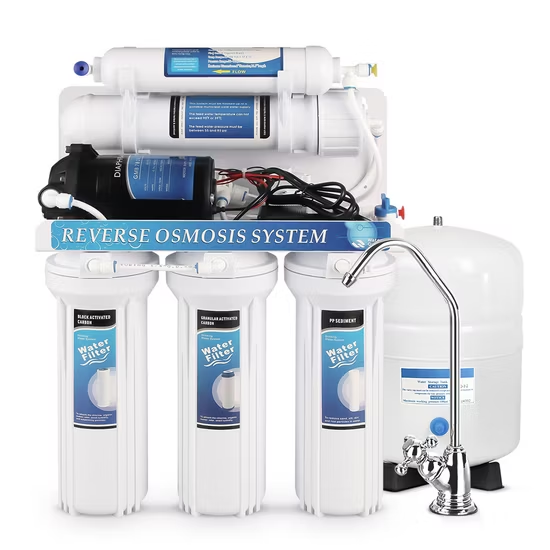
Selective Filtration vs. Reverse Osmosis (RO)
Reverse Osmosis is often seen as the heavyweight champion of filtration. It works by forcing water through an extremely fine membrane, blocking almost everything that isn’t a pure water molecule. While highly effective at removing a vast range of contaminants, it’s a bit of a sledgehammer approach.
| Feature | Selective Filtration | Reverse Osmosis (RO) |
|---|---|---|
| Contaminant Removal | Targets specific harmful contaminants. | Removes almost everything, including viruses. |
| Mineral Retention | Yes, intentionally leaves healthy minerals. | No, strips out beneficial minerals. |
| Water Waste | Very little to no water is wasted. | Wastes significant water (up to 4 gallons for 1 purified). |
| Installation | Often simpler (e.g., countertop, under-sink). | More complex, often requires a storage tank and drain line. |
| Effect on pH | Minimal impact on water pH. | Can make water slightly acidic due to mineral removal. |
RO is a powerful tool, especially for water with very high contamination levels. However, for most municipal tap water, it can be overkill, wasting water and removing the very minerals that give water its healthy properties and pleasant taste.
Selective Filtration vs. Basic Activated Carbon
You’ll find activated carbon (often from coconut shells) in everything from pitcher filters to refrigerator filters. It’s fantastic at one thing: improving taste and odor by adsorbing chlorine. But it’s a one-trick pony.
A system using selective filtration technology often includes activated carbon as one of its stages. The key difference is that it doesn’t stop there. It adds further specialized media to target the dangerous contaminants that a simple carbon filter can’t touch, like lead, mercury, and PFAS, all while preserving the water’s mineral content.
The Tangible Benefits: Why Choose a System with Selective Filtration?
Okay, the science is cool, but what does it actually mean for you and your family every day?
1. Healthier, Better-Tasting Water
By leaving in calcium, magnesium, and other electrolytes, the water doesn’t just hydrate you—it nourishes you. These minerals are vital for your body’s functions, and they also contribute to a crisp, refreshing taste. Water stripped of minerals can taste flat and unappealing.
2. Targeted, Peace-of-Mind Protection
You get the confidence of knowing your water is being filtered for the most pressing modern contaminants. Worried about lead from old city pipes? Concerned about reports of PFAS in your region? Selective filtration is specifically engineered to address these threats, giving you true peace of mind with every sip.
3. Eco-Friendly and Efficient
The massive water waste associated with Reverse Osmosis systems is a major environmental and financial drawback. Because selective filtration systems don’t need to flush contaminants down the drain with gallons of excess water, they are a far more sustainable and cost-effective choice for the conscious consumer.
Is Selective Filtration Technology Right for You?
Choosing the right filter can feel overwhelming, but it doesn’t have to be. Here’s a simple checklist to see if this technology fits your needs:
- Check Your Local Water Quality Report: Your first step should always be to understand what’s in your water. Most utility providers are required to provide an annual Consumer Confidence Report (CCR). Look for levels of chlorine, lead, and any other contaminants of local concern. You can usually find this on your town or city’s website.
- Define Your Goals: Are you primarily concerned about bad taste and smell? Or are you worried about invisible threats like heavy metals and industrial chemicals? If it’s the latter, selective filtration is a strong contender.
- Consider Your Health: Do you want to ensure your family is getting the benefits of naturally occurring minerals in your water? If so, avoiding a system that strips them out is key.
- Evaluate Your Home: Do you want a simple countertop unit, an under-sink system for your kitchen, or a whole-house solution? Systems with what is selective filtration technology come in all these forms, so you can find one that fits your lifestyle.
Frequently Asked Questions (FAQ)
What specific contaminants does selective filtration technology remove?
This technology is designed to be highly effective against a wide range of common and emerging contaminants, including but not limited to lead, chlorine, chloramine, mercury, VOCs, herbicides, pesticides, and PFOA/PFAS, while leaving beneficial minerals intact.
Does selective filtration remove fluoride?
Most selective filtration systems do not target fluoride. This is by design, as fluoride is often viewed similarly to essential minerals. If fluoride removal is a primary concern, a Reverse Osmosis system is typically the most effective option.
How is this really different from my simple pitcher filter?
Your pitcher filter likely uses a basic activated carbon block. While it’s great for reducing chlorine and improving taste, it typically isn’t certified to remove heavy metals or emerging chemical contaminants like PFAS. Selective filtration is a far more comprehensive and powerful purification method.
Is the water safe for making baby formula?
Absolutely. By removing harmful contaminants like lead while retaining natural minerals, water treated with a certified selective filtration system provides an excellent, clean base for baby formula. As always, consult your pediatrician with specific health concerns.
How often do I need to change the filters in these systems?
Filter life varies by system and your household’s water usage. Generally, you can expect to replace cartridges every 6 to 12 months. This is typically much longer than the 2-month lifespan of a standard pitcher filter.
The Smart Choice for Clean, Healthy Water
Navigating the world of water purification can be complex, but understanding what is selective filtration technology makes the choice much clearer. It’s not about brute force; it’s about intelligence. It’s about removing what harms you and keeping what helps you.
Investing in a high-quality water filter is one of the single best things you can do for your family’s health and well-being. By choosing a system that uses this advanced, targeted approach, you’re not just getting clean water—you’re getting smart, healthy, and life-giving water, just as nature intended. It’s time to take control of your tap and drink with absolute confidence.