Ensuring your family has access to clean, safe drinking water is paramount, yet distinguishing between the myriad of filtration options can be a challenging task. Two prominent water filtration technologies often come into discussion: Reverse Osmosis (RO) and Carbon Filters. While both aim to improve water quality, they operate on different principles and excel at removing distinct types of contaminants. Understanding their unique capabilities and limitations is key to selecting the system that best suits your home’s specific needs and water concerns.
What is Water Filtration and Why is it Essential?
Water filtration involves removing impurities from water to make it safer and more palatable for consumption and other household uses. Tap water, even when meeting municipal standards, can still contain a variety of contaminants such as chlorine, sediment, heavy metals, pesticides, and industrial chemicals. These impurities can affect the taste, odor, and safety of your water, potentially posing both short-term and long-term health risks. A robust filtration system not only enhances the sensory qualities of your water but also protects your health by reducing exposure to harmful substances.
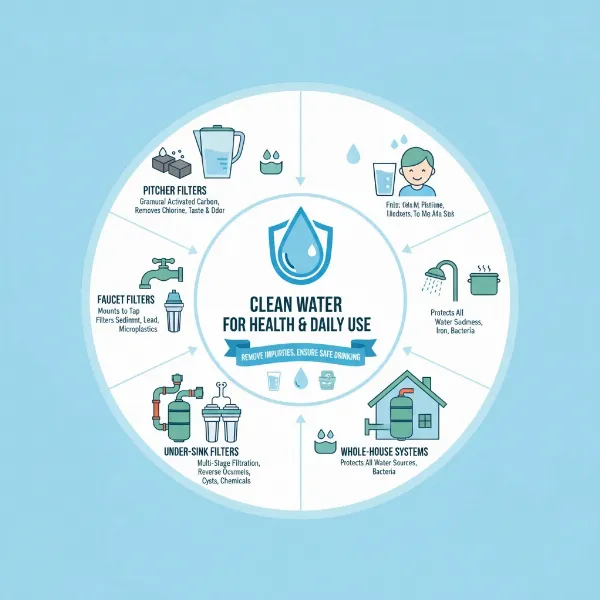 Different types of water purification systems, emphasizing clean and safe drinking water.
Understanding Carbon Filters: The Go-To for Taste and Odor
Carbon filters utilize activated carbon, a highly porous material, to attract and trap impurities through a process called adsorption. This method is particularly effective at targeting organic compounds and chemicals that influence water’s taste and smell.
How Carbon Filters Work
Activated carbon has a vast surface area with numerous tiny pores that can bind with contaminants as water passes through. The carbon’s positive charge attracts negatively charged water impurities, effectively removing them from the water stream. This makes them excellent at improving the aesthetic quality of your drinking water.
What Carbon Filters Remove
Carbon filters primarily excel at eliminating:
- Chlorine and Chloramines: Common disinfectants used in municipal water, known for their unpleasant taste and odor.
- Volatile Organic Compounds (VOCs): Organic chemicals like pesticides, herbicides, and industrial solvents.
- Sediment: Larger suspended particles like dirt, rust, and silt.
- Some Heavy Metals: Certain carbon filters, particularly those with added specific media, can reduce lead.
Advantages of Carbon Filters
Carbon filters are a popular choice for many households due to several benefits:
- Cost-Effective: They are generally more affordable upfront and have lower maintenance costs compared to RO systems.
- Easy to Install and Maintain: Many carbon filtration systems, such as pitcher filters or faucet mounts, are simple to install and require less complex maintenance.
- Improved Taste and Odor: Highly effective at removing chlorine and organic compounds, leading to noticeably better-tasting and smelling water.
- No Wastewater Production: Carbon filters do not produce any wastewater during their operation, making them water-efficient.
- Faster Flow Rate: They typically offer an instant flow of filtered water, unlike RO systems that might require a storage tank.
- Environmentally Friendly: Activated carbon is often derived from sustainable sources like coconut shells.
Disadvantages of Carbon Filters
Despite their advantages, carbon filters have limitations in the range of contaminants they can remove:
- Limited Contaminant Removal: They are not effective at removing dissolved solids (TDS), fluoride, nitrates, arsenic, bacteria, viruses, or most inorganic pollutants.
- Leaves Healthy Minerals and Hardness: While some view the retention of beneficial minerals as a pro, it also means they don’t soften water or remove minerals responsible for hard water issues.
- Does Not Remove Microbes: Carbon filters alone do not provide protection against bacteria, viruses, or other microorganisms. Removing chlorine (a germicide) without eliminating biological contaminants could, in some specific scenarios, potentially leave water vulnerable if not combined with other treatment.
Deep Dive into Reverse Osmosis (RO) Systems: Advanced Purification
Reverse Osmosis (RO) systems represent a more advanced and comprehensive water purification method. They are designed to remove a much broader spectrum of contaminants, producing highly purified water.
How Reverse Osmosis Systems Work
An RO system works by forcing water under pressure through a semi-permeable membrane. This membrane has extremely tiny pores that allow water molecules to pass through while blocking larger contaminant molecules, dissolved salts, and microscopic particles. Most RO systems are multi-stage, often including sediment pre-filters, carbon pre-filters (to protect the delicate RO membrane from chlorine), the RO membrane itself, and a post-carbon filter to polish the taste.
What Reverse Osmosis Systems Remove
RO systems are renowned for their ability to remove a vast array of impurities, including:
- Total Dissolved Solids (TDS): Removes up to 97-99% of dissolved salts, including sodium, magnesium, and calcium.
- Heavy Metals: Highly effective against lead, mercury, arsenic, cadmium, and iron.
- Inorganic Pollutants: Eliminates fluoride, nitrates, and sulfates.
- Microorganisms: Effectively removes bacteria, viruses, and parasites.
- Chemical Impurities: Filters out chlorine, pesticides, herbicides, and pharmaceuticals.
Advantages of Reverse Osmosis Systems
RO systems offer unparalleled water purification:
- Superior Purification: Provides a higher level of purification than almost any other home filtration method, producing water that is exceptionally clean and pure.
- Broad Contaminant Removal: Eliminates a wide range of dissolved solids and microscopic contaminants that carbon filters cannot.
- Improved Taste and Odor: By removing almost all impurities, RO water often has a very clean, crisp taste.
- Reduces Hard Water Issues: Effectively removes minerals that cause water hardness, benefiting appliances and plumbing.
Disadvantages of Reverse Osmosis Systems
While highly effective, RO systems come with certain drawbacks:
- Wastewater Production: RO systems typically generate a significant amount of wastewater, as concentrated contaminants are flushed away. This can range from 2 to 10 gallons of wastewater for every gallon of purified water produced.
- Removes Beneficial Minerals: The extensive filtration process removes not only harmful contaminants but also beneficial minerals like calcium and magnesium. For some, this can lead to a “flat” taste or concerns about mineral deficiency, which can be addressed with re-mineralization filters.
- Slower Flow Rate: Due to the fine membrane and pressure requirements, RO systems have a slower filtration rate and often require a storage tank to provide water on demand.
- Higher Initial Cost and Maintenance: RO systems typically have a higher upfront cost for installation and require more complex, regular maintenance, including replacing the RO membrane every 2-3 years and pre/post-filters annually.
- Potentially Acidic pH: The removal of minerals can sometimes lead to slightly acidic water, though this is often minor and can also be addressed with re-mineralization.
Side-by-Side Comparison: Carbon Filter vs. RO System
| Feature | Carbon Filter | Reverse Osmosis System |
|---|---|---|
| Purification Level | Basic to Moderate | Superior, Comprehensive |
| Contaminants Removed | Chlorine, VOCs, sediment, taste, odor, some lead | TDS, heavy metals, fluoride, nitrates, bacteria, viruses, pesticides, chlorine, VOCs, sediment |
| Removes Beneficial Minerals | No (retains them) | Yes |
| Wastewater Produced | No | Yes (significant) |
| Flow Rate | Fast, instant | Slower, often requires storage tank |
| Initial Cost | Lower ($50-$300) | Higher ($200-$800 for under-sink) |
| Maintenance Cost | Lower ($40-$100 annually) | Higher ($100-$200 annually, plus membrane replacement every 2-3 years) |
| Ease of Installation | Simple | More complex |
| Primary Use | Improving taste and odor in city water | Comprehensive purification for safety and purity |
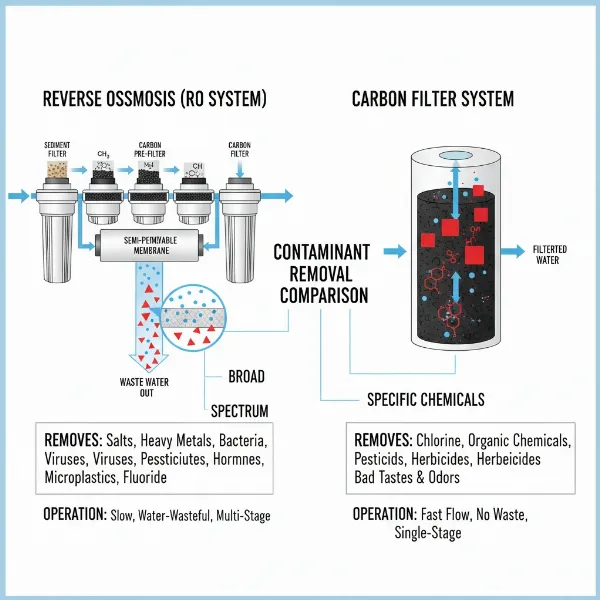 Visual comparison of reverse osmosis and carbon water filters, highlighting their differences in contaminant removal.
Making the Right Choice: Factors to Consider
Deciding between a carbon filter and an RO system, or even a combination of both, boils down to your specific circumstances and priorities.
Your Water Source and Quality
The first and most crucial step is to understand what’s in your water.
- City Water: If you have municipal water, it’s already treated to meet certain standards. Your primary concerns might be chlorine taste and odor, or perhaps specific local contaminants that aren’t fully removed. A water quality report from your municipality can provide insights.
- Well Water: Well water is unregulated and highly susceptible to various contaminants, including bacteria, viruses, heavy metals, nitrates, and other dissolved solids from the surrounding environment. Well water almost always requires more robust filtration.
Get a Water Test
A professional water test is the smartest initial step. It will accurately identify the minerals, metals, chemicals, and microbial contaminants present in your water, eliminating guesswork and guiding you toward the most effective treatment plan. Simple home test kits can give you a basic overview, but a certified lab test offers a comprehensive analysis.
Your Filtration Goals
- Taste and Odor Improvement: If your main goal is to eliminate chlorine taste, chemical odors, and improve the overall freshness of your water, a carbon filter might be sufficient and more economical.
- Comprehensive Purity and Safety: If you have well water, high levels of total dissolved solids (TDS), known contaminants like lead or fluoride, or concerns about bacteria and viruses, an RO system is the superior choice for thorough purification.
Budget and Maintenance Commitment
Consider both the upfront cost and the ongoing expenses for filters and membrane replacements. Carbon filters are generally more budget-friendly and require less intensive maintenance. RO systems, while more expensive initially and in terms of ongoing part replacement, offer a higher return on investment for serious contamination concerns.
The Power of Combining Both Systems
Many experts and homeowners find that the optimal solution involves using both technologies. In fact, most multi-stage RO systems integrate carbon filters as pre-filters (to protect the RO membrane from chlorine damage) and post-filters (to enhance taste). For a whole-house approach, some install a carbon filter at the main water entry point to improve general water quality, then add an RO system under the kitchen sink for drinking and cooking water where the highest purity is desired. This combination provides the best of both worlds: good-tasting general-use water and exceptionally pure drinking water.
Expert Tips for Water Filtration Success
- Prioritize Water Testing: “A professional water test is the smartest first step. Testing shows which minerals, metals, and other substances are in your water, so you’re not guessing.” This empowers you to make an informed decision based on actual water quality.
- Consider a Multi-Stage Approach: For robust protection and improved taste, often the most effective solution is a system that incorporates multiple filtration stages, including both sediment and carbon filtration, potentially followed by an RO membrane.
- Regular Maintenance is Key: Regardless of the system you choose, adhere to the manufacturer’s guidelines for filter and membrane replacement. Timely maintenance ensures optimal performance and prolongs the lifespan of your filtration system.
Conclusion
Choosing between a Reverse Osmosis system and a Carbon filter ultimately depends on your specific water quality, filtration goals, and budget. Carbon filters are excellent for improving the aesthetic qualities of your water by tackling chlorine and organic compounds, making them a cost-effective choice for those primarily concerned with taste and odor. Reverse Osmosis systems, on the other hand, provide a far more comprehensive purification, removing a vast range of contaminants including dissolved solids, heavy metals, and microorganisms, making them ideal for ensuring the purest, safest drinking water. Often, the most effective approach is a combination of both, leveraging the strengths of each technology for unparalleled water quality.
Ready to transform your home’s water? Take the first step by getting your water tested to understand its unique profile.
Frequently Asked Questions
Is RO water safe to drink daily?
Yes, RO water is generally safe to drink daily. However, because RO removes beneficial minerals, some people choose to remineralize their RO water or ensure they get essential minerals from their diet to avoid potential deficiencies.
Can a carbon filter remove lead?
Some carbon filters are specifically designed with additives to reduce lead levels, but not all carbon filters are effective against lead. Always check product specifications and certifications (like NSF) to confirm lead removal capabilities.
Do I need both a carbon filter and an RO system?
Many households benefit from both. Carbon filters are often used as a pre-treatment for RO systems to protect the RO membrane from chlorine, and as a post-filter for taste polishing. For whole-house benefits, a carbon filter can treat all incoming water, with an RO system providing ultra-pure drinking water at a specific tap.
How often should I change my filters?
Filter change frequency depends on the type of filter, water quality, and usage. Generally, carbon filters might need changing every 6-12 months, while RO membranes typically last 2-3 years. Always follow the manufacturer’s recommendations.
Does RO water taste flat?
Due to the removal of almost all dissolved solids and minerals, some individuals perceive RO water as having a “flat” or neutral taste compared to mineral-rich tap water. This is a matter of personal preference and can be addressed with a remineralization filter.