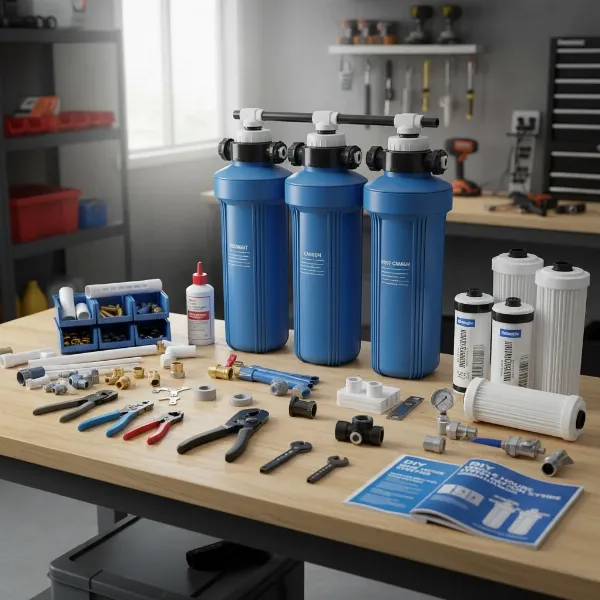
Clean, safe drinking water is a cornerstone of a healthy home, yet understanding how to achieve it can feel overwhelming. With countless filtration options available, two terms frequently arise: Granular Activated Carbon (GAC) and Carbon Block filters. While both utilize activated carbon to purify water, their distinct structures and performance characteristics mean one might be a significantly better fit for your specific needs than the other. This guide will meticulously break down the differences, benefits, and drawbacks of each type, empowering you to make an informed decision for superior water quality.
What Are Carbon Water Filters? Why Do You Need One?
At the heart of many effective home water purification systems lies activated carbon filtration. These filters leverage the remarkable adsorptive properties of specially processed carbon to capture and remove impurities from your water supply. Activated carbon is typically derived from organic materials like coconut shells, wood, or coal, which are then heated to high temperatures in a process that creates millions of tiny pores, dramatically increasing the surface area available for contaminant capture.
Our tap water, even when seemingly clear, can harbor a variety of invisible guests. Common culprits include chlorine, used as a disinfectant, which can impart unpleasant tastes and odors. Beyond aesthetics, volatile organic compounds (VOCs) from industrial runoff, pesticides, herbicides, and even certain heavy metals can find their way into our water systems, posing potential health risks. Using a carbon water filter helps address these concerns, improving not just the taste and smell of your water but also contributing to your family’s overall well-being by reducing exposure to harmful substances.
Understanding Activated Carbon Filters: GAC vs. Carbon Block
While both Granular Activated Carbon (GAC) and Carbon Block filters rely on activated carbon, their physical forms lead to significant differences in how they perform and what contaminants they excel at removing. Knowing these distinctions is crucial for selecting the right filter.
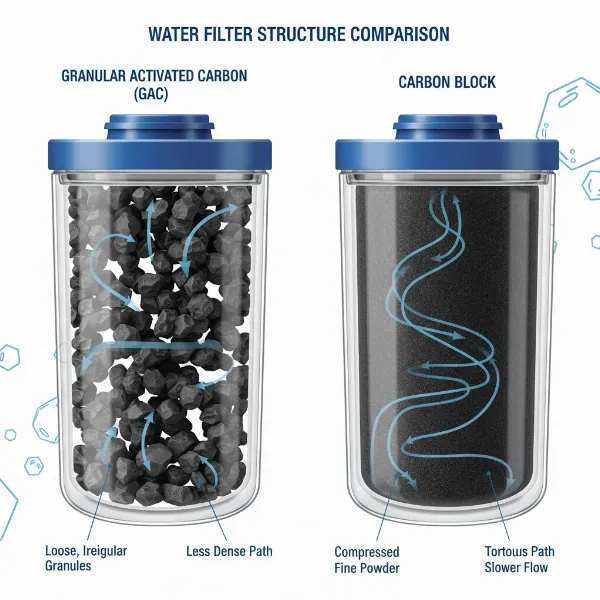 Visual comparison of granular activated carbon and carbon block filter structures, highlighting density differences.
Granular Activated Carbon (GAC) Filters
Granular Activated Carbon (GAC) filters consist of loose, irregularly shaped carbon particles packed together inside a cartridge. This design creates a less dense filter bed, allowing water to flow through more quickly. GAC filters are particularly effective at improving the aesthetic qualities of water.
How do GAC filters work? As water passes through the bed of granules, contaminants like chlorine, hydrogen sulfide, and various organic chemicals are adsorbed onto the vast surface area of the activated carbon. The larger particle size in GAC filters generally results in a faster flow rate, making them suitable for applications where high water volume is prioritized over ultra-fine filtration.
Advantages of GAC Filters:
- Cost-Effective: Generally more affordable upfront compared to carbon block filters.
- High Flow Rate: The loose granule structure allows water to pass through quickly, ideal for whole-house systems where flow isn’t significantly restricted.
- Taste and Odor Improvement: Excellent at removing chlorine, chloramines, and other compounds that cause unpleasant tastes and odors.
- Removes Organic Chemicals: Effective against many volatile organic compounds (VOCs) and certain organic chemicals.
Disadvantages of GAC Filters:
- Channeling Risk: Water can sometimes find “paths of least resistance” through the loose granules, bypassing some of the carbon and reducing filtration efficiency.
- Less Effective for Fine Particles: Not as efficient at removing very small particulate matter, sediment, or microbiological contaminants like cysts.
- Potential for “Dumping”: If a GAC filter becomes oversaturated with contaminants, there’s a risk that it could release previously adsorbed pollutants back into the water, particularly if water pressure or flow rates fluctuate.
- Microbiological Growth: Stationary pockets of water within the loose bed can sometimes become breeding grounds for bacteria, though some filters mitigate this with silver impregnation.
|
Our Picks for the Best Water Filter in 2026
As an Amazon Associate I earn from qualifying purchases.
|
||
| Num | Product | Action |
|---|---|---|
| 1 | ZeroWater 32-Cup 5-Stage Water Filter Dispenser with Instant Read Out - 0 TDS for Improved Tap Water Taste - IAPMO Certified to Reduce Lead, Chromium, and PFOA/PFOS |

|
| 2 | E-3000UV Whole House Salt-Free Water Softener & Filter Combo with UV |
|
| 3 | everydrop by Whirlpool Ice and Water Refrigerator Filter 1, EDR1RXD1, Single-Pack , Purple |
|
| 4 | everydrop® by Whirlpool Refrigerator Water Filter A - EDRARXD1 (Pack of 1) |
|
| 5 | ZeroWater 20-Cup Ready-Pour 5-Stage Water Filter Dispenser with 0 TDS Water Filter – IAPMO Certified to Reduce Lead, Chromium, and PFOA/PFOS |
|
| 6 | Samsung HAF-QIN/EXP Genuine Refrigerator Water Filter, Reduces 99% of Harmful Contaminants for Clean, Clear Drinking Water, 6-Month Life, Easy Install, Pack of 1 |
|
| 7 | FRIGIDAIRE ULTRAWF Pure Source Ultra Water Filter, Original, White, 1 Count |
|
| 8 | GLACIER FRESH Water Filter Compatible with XWFE (Built-in CHIP), Replacement for GE XWFE, XWF Refrigerator Water Filter NSF/ANSI 42 Certification Pack of 1 |
|
| 9 | Brita UltraMax Large Water Dispenser With Standard Filter, BPA-Free, Reduces Copper, Cadmium and Mercury Impurities, Lasts 2 Months or 40 Gallons, Includes 1 Filter, Kitchen Accessories, Large 27-Cup |
|
| 10 | Brita Metro Water Filter Pitcher with SmartLight Change Indicator, BPA-Free, Replaces 1,800 Plastic Water Bottles a Year, Lasts Two Months, Includes 1 Filter, Small - 6-Cup Capacity, White |
|
Carbon Block Filters
Carbon Block filters are made by compressing finely powdered activated carbon into a solid, uniform block. This process creates an extremely dense filter with a much smaller pore structure, forcing water to navigate a “tortuous path” through the carbon material. This increased contact time and finer filtration capability make carbon block filters highly effective.
The compact nature of carbon block filters allows for both adsorption and mechanical filtration (depth filtration). Contaminants are not only adsorbed onto the carbon’s surface but also physically trapped within the block’s intricate pore structure. This dual-action approach significantly enhances their ability to remove a broader spectrum of impurities.
Advantages of Carbon Block Filters:
- Superior Contaminant Removal: Highly effective at removing a wider range of contaminants, including chlorine, VOCs, lead, cysts (Giardia, Cryptosporidium), heavy metals (e.g., lead, mercury, arsenic), and some microbiological contaminants.
- Finer Filtration: Can filter out much smaller particles, often down to 0.5 microns or less, providing higher precision.
- No Channeling: The solid block structure eliminates the risk of water bypassing the carbon media, ensuring consistent and thorough filtration.
- Secure Contaminant Binding: Pollutants are more permanently bound within the dense matrix, reducing the risk of “dumping” even when the filter is nearing the end of its life.
Disadvantages of Carbon Block Filters:
- Slower Flow Rate: The dense structure and intricate pathways for water lead to a slower flow rate, which might be a consideration for whole-house applications without adequate pressure.
- Higher Initial Cost: Generally more expensive to purchase than GAC filters.
- Prone to Clogging: Due to their fine filtration capabilities, carbon block filters can become clogged with sediment more quickly in highly turbid water, potentially requiring more frequent replacement or a sediment pre-filter.
- Pressure Drop: The dense design can result in a noticeable drop in water pressure across the filter.
Granular Activated Carbon vs. Carbon Block Filters: A Detailed Comparison
Deciding between GAC and Carbon Block filters boils down to understanding their fundamental differences in structure and performance. Here’s a comparative overview:
| Feature | Granular Activated Carbon (GAC) Filters | Carbon Block Filters |
|---|---|---|
| Structure | Loose, irregularly shaped granules of activated carbon. | Finely powdered activated carbon compressed into a solid, dense block. |
| Filtration Mechanism | Primarily adsorption; water flows around granules. | Adsorption and mechanical depth filtration; water forced through tortuous path. |
| Pore Size / Filtration | Larger pores, less effective for fine particles. | Smaller, highly uniform pores, effective for sub-micron particles. |
| Contaminant Removal | Excellent for chlorine, taste, odor, hydrogen sulfide, many VOCs. | Superior for chlorine, taste, odor, VOCs, lead, cysts, heavy metals, some microbiological contaminants. |
| Flow Rate | Faster flow, lower pressure drop. Ideal for high-flow applications. | Slower flow, higher pressure drop. Ideal for point-of-use. |
| Contact Time | Shorter, as water can bypass some carbon (channeling). | Longer, ensuring maximum contact between water and carbon. |
| “Dumping” Risk | Higher risk if oversaturated or with pressure fluctuations. | Significantly lower risk due to permanent binding. |
| Lifespan | Varies (e.g., 6-9 months); can be shorter in high-contaminant areas. | Generally longer (e.g., 6-12 months or more) due to higher capacity and no channeling. |
| Cost | Generally more affordable upfront. | Higher initial cost, but potentially better long-term value. |
| Common Applications | Pitcher filters, refrigerator filters, whole-house pre-filters, high-flow systems. | Under-sink filters, countertop filters, whole-house systems (often with pre-filters), point-of-use. |
“The efficiency of any carbon filter hinges on the total surface area and the contact time water has with that carbon. Carbon block filters, by design, maximize both of these factors, offering a more robust barrier against a wider array of contaminants.” – Dr. Elena Petrova, Environmental Water Scientist
Choosing the Perfect Carbon Water Filter: Factors to Consider
Selecting the right water filter involves more than just picking a type; it’s about matching the filter to your unique water quality, usage, and budget. Here’s how to make an informed choice:
The first step is to assess your water source and contaminant concerns. Are you on municipal water, well water, or another source? Municipal water usually contains chlorine or chloramines, which both GAC and carbon block filters handle well. However, if you suspect lead, pesticides, cysts, or other heavy metals, a carbon block filter with its finer filtration and broader contaminant removal capabilities is the more prudent choice. Consider having your water tested if you’re unsure about specific pollutants.
Next, think about your usage needs. Do you need filtered water for your entire home (whole-house filtration) or primarily for drinking and cooking (point-of-use)? GAC filters offer higher flow rates, making them suitable for whole-house applications where a significant pressure drop would be inconvenient. For drinking water at the tap, where precision is paramount, a carbon block filter is often preferred, even with its slower flow. The number of people in your household and your daily water consumption will also influence filter capacity and replacement frequency.
Your budget and maintenance considerations are also key. While GAC filters often have a lower initial cost, their shorter lifespan in some situations might lead to more frequent replacements, potentially balancing out the long-term cost. Carbon block filters, though more expensive initially, can last longer and provide superior protection. Always factor in the cost and availability of replacement cartridges.
Finally, always look for quality certifications like NSF/ANSI standards. These certifications ensure that a filter has been independently tested and verified to remove the contaminants it claims. For comprehensive protection, many advanced water filtration systems effectively utilize combined filter technologies, often employing a GAC filter as a pre-filter to remove larger sediments and chlorine, followed by a carbon block filter for a final, finer purification stage.
Top Carbon Filter Applications and Recommendations
Carbon filters are incredibly versatile and can be integrated into various systems to meet diverse water purification needs. Understanding common applications helps in selecting the right setup.
For pitcher filters and refrigerator filters, GAC is the most common choice due to its ability to quickly improve taste and odor, making daily drinking water more palatable without significantly slowing down the dispensing process. These are convenient for basic improvement but offer limited contaminant removal compared to other systems.
Faucet-mounted filters and under-sink filters are typically point-of-use systems designed for higher quality drinking and cooking water. Here, carbon block filters often shine, providing superior removal of lead, VOCs, cysts, and other health-related contaminants due to their denser structure and extended contact time. Their slower flow rate is usually acceptable for this application.
For whole-house water filters, the choice depends on the primary concern. If your main issue is chlorine taste and odor throughout your home (for showering, laundry, etc.), a large GAC system can provide adequate flow and improvement. However, for more comprehensive whole-house contaminant reduction, a multi-stage system that includes a high-capacity carbon block filter, often preceded by a sediment filter and sometimes a GAC pre-filter, is recommended. This setup ensures both high flow rates and thorough purification at every tap.
Ultimately, the best recommendation often involves a layered approach. A whole-house filter (possibly GAC or a blend) can address general water quality, while a dedicated under-sink carbon block filter provides polished, highly purified drinking water where it matters most.
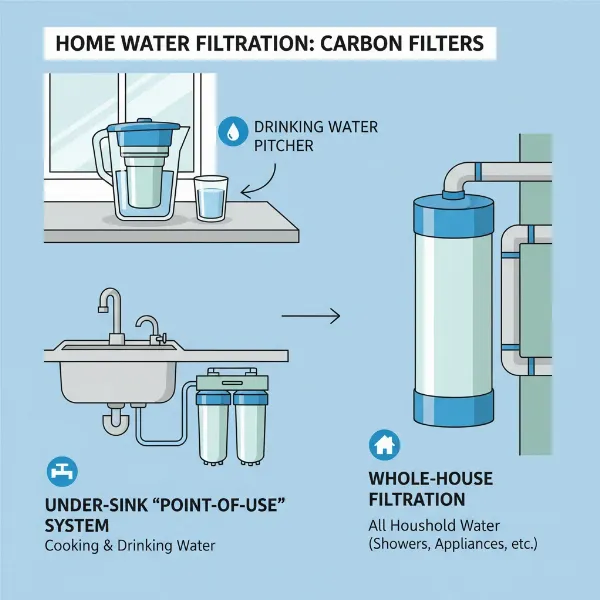 Various home water filter applications including pitcher, under-sink, and whole-house systems for different needs.
Maintaining Your Carbon Water Filter for Optimal Performance
To ensure your carbon water filter continues to provide clean and safe water, proper usage and diligent maintenance are non-negotiable. Neglecting your filter can lead to reduced effectiveness, or worse, re-releasing contaminants into your water supply.
The most critical maintenance step is regular filter replacement. All carbon filters have a finite capacity for adsorbing contaminants. Once this capacity is exhausted, the filter ceases to be effective. While manufacturers provide general guidelines (e.g., every 6-12 months for carbon block, 6-9 months for GAC), actual lifespan depends heavily on your water quality and usage volume. Pay attention to signs like a return of unpleasant tastes or odors, or a significant drop in water flow, as these often indicate it’s time for a new cartridge.
Correct installation is also key. Follow the manufacturer’s instructions carefully to ensure the filter is properly seated and sealed to prevent leaks and maximize water flow through the carbon media. For GAC filters, proper installation helps minimize the risk of channeling, ensuring water interacts fully with the carbon granules.
While most carbon filters are not designed for cleaning, monitoring for clogging is important, especially for carbon block filters in areas with high sediment. If water flow significantly diminishes, it might be a sign that the filter is clogged with particulate matter, even if its adsorptive capacity isn’t fully exhausted. In such cases, replacing the filter is necessary. Keeping a spare filter on hand can prevent interruptions in your clean water supply. By adhering to these simple maintenance practices, you extend the life of your filtration system and ensure continuous access to high-quality water.
Smart Savings: Maximizing Your Water Filter Investment
Investing in a water filter is a commitment to better health and convenience, and there are smart strategies to ensure you get the most value for your money. Making informed choices upfront and practicing good habits can lead to significant long-term savings.
One effective strategy is to choose filters with a high capacity and certified lifespan. While a filter with a higher upfront cost might seem expensive, if it lasts twice as long or handles a greater volume of water, it can be more economical in the long run than frequently replacing cheaper cartridges. Always check for NSF/ANSI certifications that specify the filter’s capacity in gallons or its rated lifespan.
Diligent maintenance and timely replacement are also crucial for maximizing your investment. Using a filter beyond its recommended lifespan not only compromises water quality but can also damage your system or lead to more costly problems down the line. Conversely, replacing it too early wastes money. Pay attention to manufacturer guidelines and monitor your water quality for signs of degradation.
Consider a multi-stage filtration system, especially one that combines GAC with carbon block filters. Often, installing an affordable sediment pre-filter can significantly extend the life of your more expensive carbon filter by removing larger particles that would otherwise clog it prematurely. A GAC stage can handle bulk chlorine removal, preserving the fine filtration capacity of a downstream carbon block for critical contaminants. This layered approach ensures efficiency, targeting specific pollutants at each stage, and ultimately provides superior water quality without breaking the bank. By strategizing your filter choices and maintenance, you secure clean water efficiently and economically.
Conclusion
Navigating the world of water filtration can seem complex, but understanding the core differences between Granular Activated Carbon (GAC) and Carbon Block filters simplifies the decision-making process. GAC filters offer excellent value for improving taste and odor with faster flow rates, making them ideal for general chlorine removal and whole-house applications where high flow is a priority. Carbon block filters, with their dense structure and superior contaminant removal capabilities, are the champions when it comes to tackling serious health concerns like lead, VOCs, and cysts, albeit with a typically slower flow.
Ultimately, the “best” Water Filter isn’t a one-size-fits-all solution; it’s the one that most effectively addresses your specific water quality challenges, fits your budget, and aligns with your household’s usage patterns. By considering the unique properties of GAC and carbon block filters, you can confidently choose a water filtration system that ensures clean, safe, and delicious water for you and your family every day. What are the most pressing water quality concerns in your home, and how will this knowledge guide your next filter purchase?
Frequently Asked Questions
What is the primary difference in how GAC and Carbon Block filters are made?
GAC filters are made from loose, granular activated carbon, allowing water to flow through relatively easily. Carbon block filters, however, are created by compressing finely powdered activated carbon into a solid, dense block, which forces water through a much more intricate path.
Which filter type is better for removing lead and other heavy metals?
Carbon block filters are generally superior for removing lead, other heavy metals, and a wider range of chemical contaminants. Their dense structure and longer contact time with water enable them to effectively trap these smaller, more dangerous particles that might bypass loose GAC granules.
Can I use both Granular Activated Carbon (GAC) and Carbon Block filters in my system?
Absolutely! Many advanced filtration systems utilize both. A common setup involves using a GAC filter as an initial stage to remove larger sediments and chlorine, followed by a carbon block filter for finer chemical removal and enhanced contaminant reduction. This combination optimizes both flow rate and purification.
Why do Carbon Block filters often have slower flow rates?
Carbon block filters have slower flow rates because of their highly compressed structure and smaller, more uniform pores. Water is forced to travel a longer, more tortuous path through the dense carbon material, increasing contact time for thorough filtration but reducing overall flow.
How often should I replace my carbon water filter?
Filter replacement frequency depends on the filter type, your specific water quality, and daily water usage. While manufacturers provide guidelines (e.g., 6-12 months), it’s best to monitor your water for returning tastes/odors or noticeable drops in flow, which indicate it’s time for a change.
Are activated carbon filters effective against bacteria and viruses?
Standard activated carbon filters (both GAC and carbon block) are generally not designed to remove bacteria and viruses effectively. While some carbon block filters can trap larger microbiological cysts like Giardia, a dedicated UV purification system or a reverse osmosis (RO) system is usually required for comprehensive microbial removal.