Choosing the right water filter pitcher can feel like navigating a maze, especially when two major players like Brita and ZeroWater dominate the market. As an Admin with over a decade of experience in water filtration, I understand the critical need for clean, safe drinking water, and the confusion that often comes with selecting the best product. This comprehensive guide will meticulously compare Brita and ZeroWater pitchers, dissecting their contaminant removal capabilities, filtration technologies, and overall value, to help you make an informed decision for your household.
What is a Water Filter Pitcher? Why Do You Need One?
A water filter pitcher is a simple, convenient, and affordable countertop device designed to improve the quality of your tap water. You simply pour tap water into an upper reservoir, and gravity pulls it through a filtration cartridge before collecting it in the pitcher below. These systems require no installation, plumbing modifications, or tools, making them ideal for renters, students, or anyone seeking an easy way to enhance their drinking water.
Tap water, while generally deemed safe, can still contain various impurities that affect taste, odor, and potentially long-term health. Common contaminants include chlorine (used for disinfection), heavy metals like lead and copper, sediment, and even emerging contaminants such as PFAS (per- and polyfluoroalkyl substances) and certain pharmaceuticals. Exposure to these substances, even at low levels, can be a concern for many. Utilizing a water filter pitcher offers numerous benefits, from enjoying better-tasting water and reducing exposure to unwanted chemicals to cutting down on plastic waste from bottled water, contributing to a healthier lifestyle and environment.
Understanding Filtration Technology: Brita vs. ZeroWater
The core difference between Brita and ZeroWater lies in their distinct filtration technologies, which directly impact what contaminants they can remove and how effectively.
Brita Filtration: The Everyday Standard
Brita, a household name in water filtration, typically employs a 2-stage filtration system, though their newer Elite filters offer enhanced capabilities. The primary components are:
- Activated Carbon: This granular material is highly effective at reducing chlorine taste and odor, which are common complaints about municipal tap water. It also targets organic compounds.
- Ion-Exchange Resin: This component focuses on reducing heavy metals like copper, cadmium, and mercury. The Brita Standard and Elite filters are certified under NSF/ANSI 53 for reducing these heavy metals. The Elite filter, a significant upgrade, is also designed to reduce 99% of lead and is certified for PFAS removal.
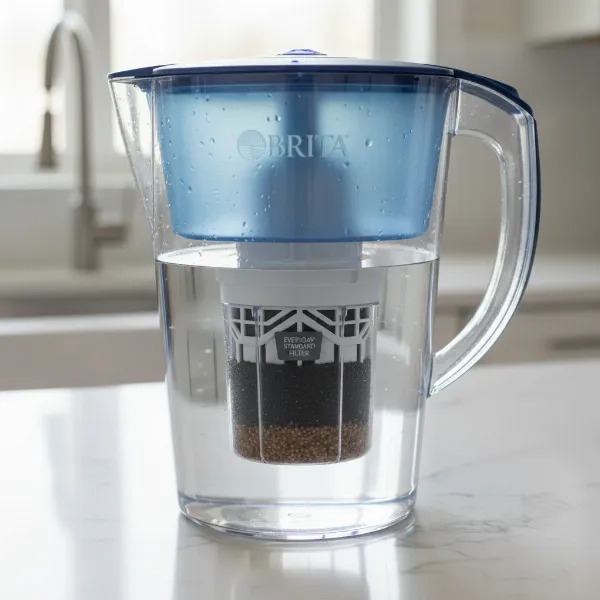 A clear Brita water filter pitcher displaying its 2-stage filter and filtered water.
While Brita filters are excellent for improving taste and reducing common impurities, they are not designed for comprehensive contaminant removal. They do not effectively remove total dissolved solids (TDS), fluoride (Brita filters are designed to retain healthy levels of fluoride), bacteria, viruses, or a wide array of pharmaceuticals and pesticides. Brita’s filters, particularly the Longlast/Elite models, are known for their longer lifespan, often lasting up to 120 gallons or six months.
ZeroWater Filtration: The Pursuit of Purity
ZeroWater stands out with its more advanced 5-stage filtration system, meticulously engineered to achieve near-zero Total Dissolved Solids (TDS). This multi-layered approach includes:
- Coarse Filter Screen: Captures larger particles like dust and rust.
- Foam Distributor: Ensures an even flow of water and removes finer sediment.
- Activated Carbon & Oxidation Reduction Alloy: Targets chlorine, chloramine, and organic compounds.
- Dual Ion-Exchange Resin: This crucial stage removes virtually all inorganic compounds, including heavy metals, non-metal inorganic contaminants, and radiological contaminants. This is where the significant TDS reduction occurs.
- Non-Woven Membrane: Filters out ultra-fine particles and ensures the final water quality.
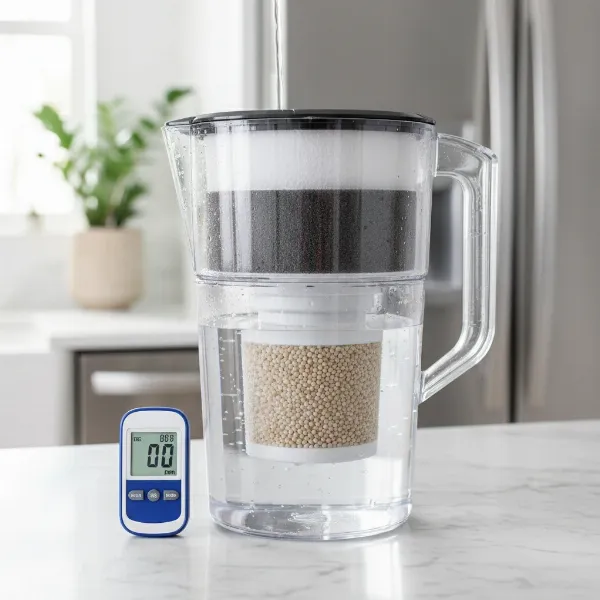 A ZeroWater pitcher showcasing its advanced 5-stage filtration system and a TDS meter.
ZeroWater’s technology is designed to deliver water with a TDS reading of 0 ppm, effectively removing a much broader spectrum of contaminants compared to Brita. This includes lead, fluoride, PFAS (forever chemicals), chromium, mercury, nitrate, uranium, strontium, molybdenum, sulfate, and barium. The company often includes a TDS meter with its pitchers, allowing users to verify the filter’s performance themselves.
Contaminant Removal Face-Off: Who Wins?
When the primary goal is maximum contaminant removal, ZeroWater unequivocally takes the lead. Its 5-stage filtration system is engineered to reduce virtually all Total Dissolved Solids (TDS) to near zero, a claim frequently validated by independent testing. For instance, tests have shown ZeroWater reducing TDS from typical tap water readings (e.g., 187 ppm) to an astonishing 0 ppm. [cite: 3, 5 (from first search)] In contrast, Brita pitchers typically achieve a more modest reduction in TDS, often leaving a significant amount of dissolved solids in the water (e.g., from 187 ppm to 147 ppm, a 21.4% reduction). [cite: 3, 5 (from first search)]
Here’s a breakdown of specific contaminant removal:
- Lead: Both brands offer lead reduction. Brita’s Elite filter reduces 99% of lead, while ZeroWater is also certified for lead removal, often achieving 100% reduction in tests.
- Fluoride: ZeroWater is highly effective at removing fluoride, often eliminating it completely. Brita filters, on the other hand, are designed to retain fluoride, as it is often added to municipal water for dental health.
- PFAS (Forever Chemicals): ZeroWater is certified to reduce PFOA/PFOS and other PFAS. Brita’s Elite filter is also certified for PFAS removal.
- Chlorine: Both filters effectively remove chlorine taste and odor. Brita removes about 96% of chlorine, while ZeroWater removes 99%. [cite: 1 (from first search)]
- Nitrate: ZeroWater has shown 100% removal of nitrate, a significant advantage for those with well water or specific concerns. Brita offers only a minimal reduction in nitrate. [cite: 4 (from third search)]
- Heavy Metals (beyond Lead): ZeroWater consistently outperforms Brita in removing a wider range of heavy metals, including strontium, molybdenum, sulfate, and barium, often achieving 100% reduction. Brita filters reduce copper, cadmium, and mercury. [cite: 2 (from second search)]
It’s important to note that certifications from organizations like NSF, IAPMO, and WQA are crucial indicators of a filter’s performance. ZeroWater (particularly the newer Culligan models) boasts certifications for a broader array of contaminants it claims to remove, aligning with its comprehensive filtration philosophy. [cite: 2 (from first search)] However, for general improvement of municipal tap water taste and odor, Brita’s certified reductions for chlorine, lead, and certain heavy metals are often sufficient.
Beyond Contaminants: Taste, Speed, and Healthy Minerals
While contaminant removal is paramount, other factors significantly influence the user experience.
Taste Profile
The taste of filtered water can be a subjective but critical consideration.
- ZeroWater: The ultra-pure water produced by ZeroWater’s extensive filtration often has a distinctive “flat” or “crisp” taste, similar to distilled water. Many describe it as the cleanest water they’ve ever had, while some find the absence of minerals gives it an almost sour quality. [cite: 1, 4 (from third search)] A notable drawback is that as a ZeroWater filter reaches the end of its lifespan and becomes saturated, it can suddenly release trapped contaminants, leading to a noticeable drop in pH and an unpleasant, often fishy or acidic taste. [cite: 1 (from third search)]
- Brita: Brita-filtered water tends to taste more like conventional spring water – clean and fresh, but with some natural minerals retained. Its primary focus is on removing chlorine taste and odor, resulting in a noticeably improved but still familiar water flavor. [cite: 1 (from third search)]
Filtration Speed
For busy households, filtration speed can be a major practical difference.
- Brita: Brita filters water considerably faster than ZeroWater, sometimes up to four times quicker. This speed is a significant advantage when you need water rapidly for drinking, cooking, or filling multiple bottles. [cite: 5 (from first search)]
- ZeroWater: Due to its thorough 5-stage process, ZeroWater’s filtration is inherently slower, often taking 15-30 minutes for a full pitcher. While this patience yields purer water, it can be a minor inconvenience for immediate needs. [cite: 1, 5 (from first search)]
Mineral Retention
This is a key philosophical difference between the two brands.
- ZeroWater: By design, ZeroWater removes nearly all Total Dissolved Solids, which includes healthy minerals like calcium, magnesium, and potassium. While some prefer this ultra-pure water, others argue that beneficial minerals are stripped away. [cite: 1, 2, 3, 4 (from second search of “Brita filter effectiveness vs ZeroWater”)]
- Brita: Brita’s filtration process is designed to reduce harmful contaminants while retaining some of the natural, healthy minerals found in water. This often results in a taste profile closer to that of bottled spring water. [cite: 1, 2, 3, 5 (from first search of “Brita filter effectiveness vs ZeroWater”)]
“For truly comprehensive contaminant removal, ZeroWater is technically superior, reducing Total Dissolved Solids to near-zero. However, if retaining beneficial minerals and faster filtration speed are priorities, Brita presents a compelling alternative for most municipal water supplies.” – Dr. Alex Nguyen, Environmental Water Quality Specialist
Cost of Ownership and Filter Lifespan
The initial purchase price of a pitcher is only part of the equation; ongoing filter replacement costs significantly impact the long-term value.
- Initial Pitcher Cost: Both Brita and ZeroWater offer pitchers in similar price ranges, typically from $20 to $50, depending on the model and capacity.
- Filter Lifespan & Replacement Cost: This is where the financial differences become pronounced.
- ZeroWater Filters: Have a shorter lifespan, usually rated for approximately 20-40 gallons. This means more frequent filter changes, especially in areas with higher initial TDS levels. While individual ZeroWater filters may seem similarly priced to Brita’s at around $15-25 each, the frequent replacements lead to a higher annual cost of ownership. The included TDS meter helps users monitor filter saturation and know exactly when to replace it.
- Brita Filters: The standard Brita filters last around 40 gallons, but the Brita Longlast or Elite filters boast an impressive lifespan of up to 120 gallons or about six months. This extended life makes Brita filters more cost-effective in the long run, even if the individual filter price per unit is sometimes slightly higher (around $17 for an Elite filter). Despite the longer lifespan, regular filter changes are crucial to prevent potential biofilm growth and maintain performance.
Therefore, while ZeroWater offers superior contaminant removal, it comes with a higher ongoing financial commitment due to more frequent filter replacements. Brita, particularly with its Longlast/Elite filters, offers a more budget-friendly option for routine filtration.
How to Choose the Perfect Water Filter Pitcher for Your Home
Selecting between Brita and ZeroWater ultimately depends on your specific needs, local water quality, and personal preferences.
- Assess Your Water Quality: The most crucial first step is to understand what’s in your tap water. Consider having your water tested for specific contaminants like lead, fluoride, nitrates, or PFAS. If you have particularly challenging water with high TDS or specific heavy metal concerns, ZeroWater’s comprehensive filtration might be necessary. For common issues like chlorine taste and some heavy metals, Brita may suffice.
- Prioritize Contaminant Removal vs. Convenience:
- Choose ZeroWater if:
- Your top priority is maximum contaminant removal, including a wide range of dissolved solids, lead, fluoride, and PFAS.
- You prefer water with a near-zero TDS reading.
- You are willing to invest more in filter replacements and tolerate slower filtration speed for superior purity.
- You have specific health concerns related to numerous water impurities.
- Choose Brita if:
- You primarily want to improve the taste and odor of your tap water by reducing chlorine.
- You are concerned about common contaminants like lead, copper, and mercury.
- You value faster filtration speed and a more affordable long-term cost of ownership.
- You prefer water that retains some natural minerals.
- Choose ZeroWater if:
- Consider Your Usage Habits: For a large family that needs filtered water quickly and frequently, Brita’s speed might be a deciding factor. If you only need filtered water for drinking and don’t mind waiting, ZeroWater’s thoroughness could be more appealing.
By carefully evaluating these factors, you can align your choice with the best solution for your household’s water filtration needs.
Conclusion
The debate between Brita and ZeroWater pitchers highlights a fundamental choice in water filtration: targeted improvement versus ultimate purity. ZeroWater, with its advanced 5-stage filtration system, consistently outperforms Brita in removing a broader spectrum of contaminants, including nearly all Total Dissolved Solids, lead, fluoride, and PFAS. This makes it the clear winner for those prioritizing the absolute purest water. However, this superior purification comes with trade-offs: a slower filtration rate, removal of healthy minerals, and significantly higher ongoing costs due to more frequent filter replacements.
Brita, on the other hand, offers a practical, affordable solution for everyday water enhancement. Its activated carbon and ion-exchange resin filters effectively reduce chlorine taste and odor, along with common contaminants like lead and copper, while retaining beneficial minerals and providing much faster filtration.
Ultimately, the “better” pitcher depends entirely on your specific circumstances. Are you seeking comprehensive contaminant elimination, or are you primarily focused on improving taste and addressing common impurities? Understanding your local water quality and personal priorities will guide you to the ideal choice. Which water filter pitcher will you choose to ensure cleaner, safer water for your family?
Frequently Asked Questions
Does ZeroWater remove healthy minerals from water?
Yes, ZeroWater’s 5-stage filtration system is designed to remove virtually all Total Dissolved Solids (TDS), which includes naturally occurring healthy minerals like calcium, magnesium, and potassium, alongside contaminants.
Why does ZeroWater filtered water sometimes taste different or sour?
ZeroWater aims for near-zero TDS, which can result in a “flat” or “pure” taste due to the absence of minerals. When the filter is saturated and needs replacement, it can release trapped contaminants, causing a sudden drop in pH and a sour, acidic, or even fishy taste.
How often should I change my Brita vs. ZeroWater filter?
Brita Standard filters last about 40 gallons or 2 months, while Brita Longlast/Elite filters can last up to 120 gallons or 6 months. ZeroWater Filters have a shorter lifespan, typically 20-40 gallons, and should be changed when the included TDS meter reads above 006 ppm.
Is Brita or ZeroWater better for lead removal?
Both Brita and ZeroWater pitchers are certified to reduce lead. ZeroWater typically achieves near 100% lead removal due to its comprehensive filtration, while Brita’s Elite filter is certified to remove 99% of lead. For significant lead concerns, ZeroWater offers a more thorough approach.
Can Brita filters remove fluoride from water?
No, Brita filters are generally designed to retain healthy levels of fluoride, which is often added to municipal water supplies for dental health. ZeroWater, however, is highly effective at removing fluoride.