Navigating tap water quality in an apartment or rental property can be a significant challenge, especially when permanent plumbing modifications are out of the question. You want clean, safe drinking water for yourself and your family, but traditional whole-house or under-sink filtration systems simply aren’t feasible. This guide delves into the world of countertop water filters, offering a comprehensive look at the best options available, how they work, and what to consider, ensuring you can enjoy pure water without breaking your lease.
What is a Countertop Water Filter? Why Do You Need One?
A countertop water filter is a portable water purification device designed to sit on your kitchen counter, providing filtered water without requiring permanent installation or extensive plumbing work. These systems are invaluable for renters and apartment dwellers who cannot alter their property’s plumbing. Unfiltered tap water can contain a surprising array of contaminants, from common culprits like chlorine, which affects taste and odor, to more concerning substances such as lead, PFOA/PFOS, pesticides, herbicides, cysts, and even microplastics. Consuming these impurities can lead to various health concerns over time, impacting overall well-being.
The benefits of using a countertop water filter extend beyond just safety. Filtered water often tastes significantly better, encouraging increased hydration. It can also improve the flavor of coffee, tea, and cooked foods. For renters, the ease of installation (often just a plug-in or faucet attachment) and portability are key advantages, allowing you to take your filtration system with you when you move, ensuring a consistent source of clean water wherever you go. These systems offer peace of mind, knowing your drinking water is free from harmful contaminants.
 Happy person in apartment drinking filtered water from a countertop water filter.
Popular Types of Countertop Water Filters on the Market
Countertop water filters come in several distinct styles, each with unique advantages and suitable for different needs and preferences. Understanding these types is crucial for making an informed decision for your apartment.
Faucet-Mounted Countertop Filters
These systems connect directly to your kitchen faucet via a diverter, allowing you to easily switch between filtered and unfiltered tap water. Installation is typically straightforward, often requiring no tools, making them an excellent choice for renters seeking minimal setup. The Brondell Cypress, for instance, offers fast filtration and a compact design, connecting directly to the faucet. They are generally space-efficient but might not be compatible with all faucet types, such as pull-down or pull-out models.
Gravity-Fed Countertop Filters
Gravity-fed filters feature upper and lower chambers. You pour untreated water into the top chamber, and gravity slowly draws it through filtration elements into the bottom chamber, where it’s ready for dispensing. These systems require no electricity or plumbing, making them highly versatile and even suitable for emergency use. The Big Berkey Water Filter and the British Berkefeld are prominent examples, known for their large capacities and long-lasting filters. While they take up more vertical space and filter water slowly, they are robust and excellent for households that prioritize self-sufficiency and high-volume filtration.
Pour-Through (Pitcher-Style) Countertop Filters
Essentially larger versions of water filter pitchers, these freestanding units sit on your counter and often include a dispenser tap. You manually fill a reservoir with tap water, and it filters into a lower chamber or removable carafe. These are among the most portable and budget-friendly options, requiring no installation at all. Examples include the Culligan ZeroWater Pitcher, Epic Pure Water Filter Pitcher, and LifeStraw Water Filter Dispenser. They are ideal for individuals or small households with limited counter space, offering convenience and decent contaminant reduction. However, their capacity and filtration speed might be lower than other countertop types, and frequent refilling may be necessary.
Countertop Reverse Osmosis (RO) Systems
For the highest level of purification without an under-sink installation, countertop reverse osmosis systems are a top choice. These units push water through a semi-permeable membrane to remove even microscopic contaminants like dissolved solids, heavy metals, and chemicals that other filters might miss. The AquaTru Countertop Water Filtration System, Waterdrop A1, and AlcaPure Countertop Reverse Osmosis Filter are highly-rated examples. While they tend to be larger, more expensive, and may produce some wastewater, their superior contaminant reduction capabilities are unmatched. Many offer plug-and-play setup and digital displays for maintenance alerts.
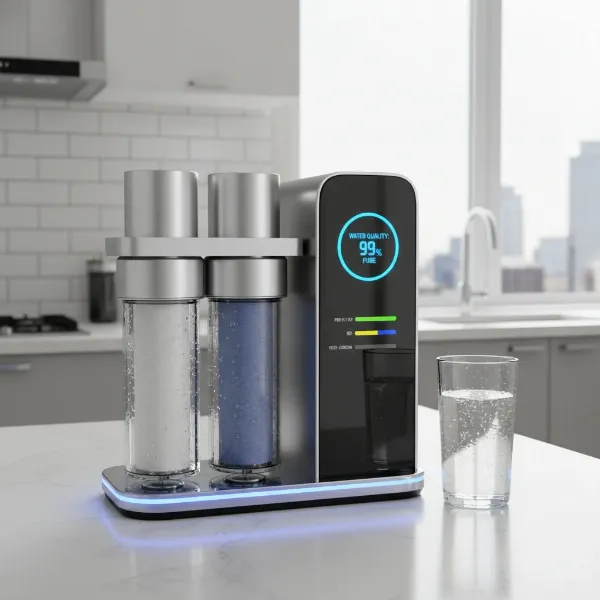 Advanced countertop reverse osmosis system with multiple stages and digital display in a kitchen.
Comparing Countertop Water Filters: A Detailed Table
| Feature | Faucet-Mounted (e.g., Brondell Cypress) | Gravity-Fed (e.g., Big Berkey, British Berkefeld) | Pour-Through (e.g., Culligan ZeroWater, Epic Pure) | Countertop RO (e.g., AquaTru, Waterdrop A1) |
|---|---|---|---|---|
| Installation | Attaches to faucet, no tools needed | Freestanding, no plumbing/electricity | Freestanding, no plumbing/electricity | Plug-and-play, electricity needed |
| Contaminants Removed | Chlorine, VOCs, lead, PFOA/PFOS, bacteria, viruses | Chlorine, heavy metals, VOCs, bacteria, cysts, some fluoride (with add-ons) | Chlorine, lead, fluoride, nitrates, TDS, microplastics | 80+ contaminants including lead, arsenic, fluoride, PFAS, nitrates |
| Filtration Speed | Instant | Slow (gravity-fed) | Moderate (pitcher refilling) | Moderate (tank refilling, RO process) |
| Space Requirement | Compact, near faucet | Significant vertical space | Minimal, fits in fridge sometimes | Moderate to significant |
| Mineral Retention | Yes | Yes | May remove some beneficial minerals | No (removes most minerals), some offer remineralization |
| Certifications | NSF/ANSI 42, 53, 372 (WQA Gold Seal) | NSF 53, 42 (independent labs) | NSF/ANSI 42, 53, 401, 372 (IAPMO certified for claims) | NSF/ANSI 42, 53, 58, 401, P473 (IAPMO certified) |
| Approx. Annual Cost (Filters) | ~$100 (Brondell) | ~$70-100 (Berkey); ~$30-60 (Berkefeld) | ~$150-160 (Culligan, Epic, Clearly Filtered) | ~$100-130 (AquaTru, Waterdrop) |
| Portability | Good (detachable) | Excellent (no connections) | Excellent | Good (plug-and-play) |
Guide to Buying a Countertop Water Filter: Factors to Consider
Choosing the right countertop water filter for your apartment requires careful consideration of several factors to ensure it meets your specific needs without violating rental agreements.
Water Source and Contamination
Before purchasing, determine your water source. If you rely on municipal tap water, your city’s annual water quality report (available from your utility department) will detail common contaminants in your area. For well water users, a private lab test is essential to identify specific pollutants like bacteria, nitrates, or heavy metals. Understanding what’s in your water will help you select a filter designed to target those particular contaminants effectively.
Usage Needs
Consider your household size and daily water consumption. A small pitcher filter might suffice for one or two people primarily drinking water, but a larger gravity-fed system or countertop RO unit would be more practical for families or those who also use filtered water for cooking. Think about the purpose as well; a basic carbon filter improves taste, while an RO system provides maximum purification for sensitive uses.
Budget
Countertop water filters vary widely in price, from under $50 for basic pitchers to over $500 for advanced RO systems. Beyond the initial purchase price, factor in the ongoing cost of replacement filters. Some filters, like RO membranes, last longer but are more expensive, while others require more frequent, but cheaper, replacements.
Brand and Supplier
Opt for reputable brands known for quality and customer service. Purchase from authorized retailers or directly from the manufacturer to avoid counterfeit products, which can be less effective and potentially unsafe. “If the cost seems too good to be true, it probably is,” notes Rick Andrew, formerly of NSF International’s Global Water Program, regarding counterfeit filters.
Quality Certifications
Third-party certifications are critical indicators of a filter’s performance and safety claims. Look for seals from organizations like NSF International, ANSI, or the Water Quality Association (WQA). These certifications (e.g., NSF/ANSI 42 for aesthetic effects, 53 for health effects, 58 for RO systems, 401 for emerging contaminants, and 372 for lead-free components) ensure that the filter has been independently tested and verified to perform as advertised. Be wary of vague claims like “tested to” or “meets” standards, as these do not equate to full certification.
Renter-Specific Considerations
For apartments and rentals, ease of installation and portability are paramount. Choose systems that don’t require drilling, plumbing alterations, or permanent fixtures. Freestanding or faucet-diverter models are generally ideal. Consider the unit’s footprint and height to ensure it fits comfortably on your countertop without obstructing cabinets or taking up too much precious space.
Top-Rated Countertop Water Filters for Apartments and Renters
Based on performance, ease of use for renters, and contaminant reduction capabilities, here are some of the best countertop water filters available:
AquaTru Countertop Reverse Osmosis System
The AquaTru consistently ranks as a top performer for its exceptional contaminant reduction. This countertop RO system is highly efficient, reducing 83+ contaminants including lead, fluoride, arsenic, and PFOA/PFOS, and boasts extensive NSF certifications (42, 53, 58, 401, 372). It’s a plug-and-play system, making it ideal for apartments, and its highest efficiency among countertop RO units means less water waste. While it’s a higher upfront investment, its superior purification and ease of setup make it a worthwhile choice for those prioritizing the purest water. Some models even offer remineralization options.
Brondell Cypress Three-Stage Countertop Water Filtration System
For a balance of convenience and effective filtration, the Brondell Cypress is an excellent choice. This faucet-connected system offers a three-stage Nanotrap filtration that captures bacteria, viruses, VOCs, chlorine, and heavy metals. It’s compact, sleek, and incredibly easy to set up in about 10 minutes with most standard faucets, requiring no permanent modifications. Its WQA Gold Seal certification to NSF/ANSI standards 42, 53, and 372 further assures its performance. It delivers instant, clean-tasting water, making it perfect for busy renters.
Big Berkey Water Filter
If you need a large capacity and robust off-grid capabilities, the Big Berkey is a perennial favorite. This gravity-fed stainless steel system holds over two gallons and can purify up to 6,000 gallons per filter set, lasting years for a typical household. It removes heavy metals, VOCs, chlorine, and significantly improves taste and odor without needing electricity or plumbing. While its size requires dedicated counter space, its durability, long-lasting filters, and ability to handle untreated water sources make it a versatile option for renters, particularly those who value self-reliance. Note that while tested to NSF standards by independent labs, Big Berkey does not carry an official NSF seal on the unit itself.
Culligan ZeroWater Pitcher
For renters on a tighter budget or with very limited counter space, the Culligan ZeroWater Pitcher offers impressive performance in a portable format. It uses a dual ion exchange filter to achieve RO-like contaminant reduction, including fluoride, lead, and nitrates, and is IAPMO certified to NSF standards 42, 53, and 401 for its reduction claims. Its compact design and no-hassle setup make it highly apartment-friendly. While its filter capacity (20 gallons) is lower, leading to higher annual replacement costs compared to some larger systems, its affordable upfront price and effective filtration make it an excellent entry-level choice for clean water.
Using and Maintaining Your Countertop Water Filter
Proper use and maintenance are crucial for the longevity and effectiveness of your countertop water filter. Most systems are designed for easy, renter-friendly installation. For faucet-mounted units, simply attach the provided adapter to your sink faucet. Freestanding and RO systems generally require plugging into an electrical outlet and filling a reservoir. Always follow the manufacturer’s specific instructions for initial setup, which often includes flushing the system with water a few times before first use to condition the filters.
Regular cleaning of the external unit and tanks is important to prevent mold or bacterial growth. The most critical maintenance task is timely filter replacement. Each filter type has a recommended lifespan, typically ranging from a few months to a year or more, depending on usage and water quality. Many modern systems include indicator lights or digital displays to alert you when it’s time for a change. Ignoring these alerts can lead to reduced filtration efficiency and potentially expose you to contaminants. Keep spare filters on hand to ensure uninterrupted access to clean water.
Tips for Saving Money on Countertop Water Filters
Investing in a countertop water filter is a commitment to healthier living, but there are ways to manage the costs effectively.
- Choose filters with a longer lifespan: While some filters might have a higher upfront cost, their extended lifespan can result in lower annual replacement expenses. RO membranes, for example, typically last longer than carbon filters.
- Regularly clean your filter system: For gravity-fed systems, gently cleaning the ceramic filter elements can sometimes extend their life and maintain flow rate, though always follow manufacturer guidelines.
- Purchase authentic replacement filters from authorized sellers: Counterfeit filters are not only ineffective but can also damage your system and compromise your water quality. Buying genuine parts ensures optimal performance and protects your investment.
- Utilize filtered water wisely: While tempting to use filtered water for everything, prioritize it for drinking and cooking. For tasks like washing dishes or general cleaning, unfiltered water is often sufficient, thus extending the life of your filters.
Conclusion
Choosing the best countertop water filter for your apartment or rental property empowers you to take control of your drinking water quality without the complexities of permanent installations. From compact pitcher filters to powerful reverse osmosis systems, there’s a solution to fit every budget, space constraint, and contamination concern. By considering factors like your water source, usage needs, certifications, and long-term costs, you can confidently select a filter that ensures a consistent supply of clean, great-tasting water for you and your family. Enjoying pure water in your rental has never been easier or more accessible.
What kind of water filter best suits your apartment living?
Frequently Asked Questions
What is the primary benefit of a countertop water filter for renters?
The main benefit of a countertop water filter for renters is that it provides access to filtered water without requiring any permanent plumbing modifications or installation. This portability means you can easily set it up, take it with you when you move, and avoid violating lease agreements that often prohibit altering fixtures.
Do all countertop water filters remove fluoride?
No, not all countertop water filters remove fluoride. Fluoride reduction typically requires advanced filtration stages, most commonly found in reverse osmosis (RO) systems or those using activated alumina filters. Always check the product specifications and certifications, such as NSF/ANSI 58 for RO, if fluoride removal is a priority for you.
How often should I replace the filters in my countertop system?
The frequency of filter replacement varies significantly depending on the filter type, brand, and your household’s water usage and local water quality. Most countertop filters require replacement every three to twelve months, though some RO membranes can last up to two years. Always consult your specific model’s user manual for the recommended schedule.
Are countertop RO systems worth the investment for an apartment?
Countertop RO systems like the AquaTru are often considered worth the investment for apartments if you desire the highest level of contaminant removal. They are effective against a broad spectrum of pollutants, including dissolved solids, heavy metals, and chemicals. While they are a larger investment and may produce some wastewater, their superior purification capabilities provide exceptional peace of mind.
Can I use a countertop water filter if I have hard water in my apartment?
Yes, you can use a countertop Water Filter with hard water, but its effectiveness in reducing hardness minerals (calcium and magnesium) will vary by type. Reverse osmosis systems are highly effective at removing these minerals. Other filters, particularly carbon-based ones, may improve taste and odor but typically do not soften water to a significant degree.