In an era where clean drinking water is a growing concern, many households seek reliable filtration solutions. The Berkey water filter system has long stood out as a prominent choice, lauded for its powerful gravity-fed purification. But with a market saturated with options, the question remains: is the Berkey still the gold standard for gravity-fed filtration, or have newer contenders surpassed its legendary status? This comprehensive review dives deep into the Berkey’s performance, features, advantages, and disadvantages to help you determine if it’s the right fit for your family’s water needs.
What is a Berkey Water Filter? Why Do You Need One?
A Berkey water filter is a self-contained, gravity-fed water purification system designed to provide clean and safe drinking water without electricity or plumbing. It typically consists of two stainless steel chambers: an upper chamber for unfiltered water and a lower chamber for purified water. Water is poured into the top, slowly drips through proprietary Black Berkey purification elements, and collects in the bottom reservoir.
The necessity for a robust water filter stems from the pervasive presence of contaminants in both municipal and well water sources. Tap water, while treated, can still contain chlorine, disinfection byproducts, heavy metals like lead and copper, pesticides, pharmaceuticals, and even some viruses and bacteria. Consuming these contaminants over time can lead to various health issues, from gastrointestinal problems to more severe chronic conditions. A Berkey system offers a line of defense, significantly reducing or removing a broad spectrum of these impurities, thus safeguarding your family’s health and improving the taste and odor of your drinking water.
Exploring Common Berkey Water Filter Models
Berkey offers a range of systems, each designed to cater to different household sizes and portability needs. All models operate on the same gravity-fed principle, utilizing the powerful Black Berkey purification elements.
- Travel Berkey: The most compact model, holding approximately 1.5 gallons (5.8 liters). Ideal for 1-2 people, small apartments, travel, or camping.
- Big Berkey: The most popular choice, with a 2.25-gallon (8.5-liter) capacity. Suitable for 1-4 people, offering a balance of capacity and countertop footprint.
- Royal Berkey: A larger option at 3.25 gallons (12.3 liters), serving 2-6 people. Great for medium-sized families.
- Imperial Berkey: With a 4.5-gallon (17-liter) capacity, this model is designed for 4-8 people or small groups.
- Crown Berkey: The largest system, holding 6 gallons (22.7 liters). Best for large families, communities, or emergency preparedness for bigger groups.
Each model’s capacity scales up, but the core purification technology remains consistent, ensuring high-quality water across the range.
Berkey’s Filtration Technology: How Effective Is It?
At the heart of every Berkey system are the Black Berkey purification elements, renowned for their ability to remove an extensive list of contaminants. These filters are made from a proprietary combination of six different media types, forming a tortuous path through which water must pass. This intricate structure, combined with micro-filtration, adsorption, and ionic absorption, is designed to eliminate pathogens and chemicals.
Berkey systems are often praised for their effectiveness against bacteria, cysts, and viruses, achieving high reduction rates. They also target inorganic minerals such as lead, mercury, and copper, as well as organic compounds, volatile organic compounds (VOCs), pesticides, and herbicides. Chlorine and chloramines are also significantly reduced, often improving the taste and odor of tap water. For enhanced filtration, particularly concerning fluoride and arsenic, Berkey offers optional PF-2 fluoride and arsenic reduction filters that attach to the Black Berkey elements.
Independent lab testing, however, presents a more nuanced picture. While some tests confirm excellent removal of chlorine, lead, copper, and disinfection byproducts, results can vary for other contaminants. For example, some reports indicate that Berkey systems perform averagely on contaminants like sulfate and iron, and nitrate reduction can be minimal. A notable point of contention surrounds the PF-2 fluoride filters, with some third-party tests suggesting they may leach aluminum oxide into the water in certain conditions, and fluoride reduction rates have sometimes fallen short of Berkey’s advertised claims. While some tests showed 100% fluoride reduction with PF2 filters after a retest, others reported around 67% reduction. This highlights the importance of thorough priming and regular maintenance.
Pros and Cons of Berkey Water Filters
Understanding both the strengths and weaknesses of Berkey systems is crucial for an informed decision.
Advantages of Berkey Water Filters:
- Exceptional Contaminant Removal: Black Berkey elements are designed to remove a vast array of contaminants, including bacteria, viruses, heavy metals, chlorine, and various chemicals, making water safe to drink.
- No Electricity Required: As a gravity-fed system, Berkey filters operate without power, making them ideal for off-grid living, emergencies, and situations where electricity is unavailable.
- Portability and Durability: Constructed from high-grade stainless steel, Berkey systems are robust and durable. Their portable design allows them to be used at home, while camping, or during travel.
- Long Filter Lifespan: The Black Berkey purification elements boast an impressive lifespan, capable of filtering up to 6,000 gallons (3,000 gallons per filter element) before needing replacement. This translates to a low cost per gallon over time.
- Retains Beneficial Minerals: Unlike some other filtration methods (like reverse osmosis), Berkey filters are designed to leave essential minerals in the water, contributing to a healthier and better-tasting product.
- Versatility: Capable of purifying both treated tap water and untreated raw water sources like lakes and rivers (with proper pre-filtration for heavily turbid water).
|
Our Picks for the Best Water Filter in 2026
As an Amazon Associate I earn from qualifying purchases.
|
||
| Num | Product | Action |
|---|---|---|
| 1 | FRIGIDAIRE ULTRAWF Pure Source Ultra Water Filter, Original, White, 1 Count |

|
| 2 | GLACIER FRESH Water Filter Compatible with XWFE (Built-in CHIP), Replacement for GE XWFE, XWF Refrigerator Water Filter NSF/ANSI 42 Certification Pack of 1 |
|
| 3 | ZeroWater 20-Cup Ready-Pour 5-Stage Water Filter Dispenser with 0 TDS Water Filter – IAPMO Certified to Reduce Lead, Chromium, and PFOA/PFOS |
|
| 4 | E-3000UV Whole House Salt-Free Water Softener & Filter Combo with UV |
|
| 5 | Brita Metro Water Filter Pitcher with SmartLight Change Indicator, BPA-Free, Replaces 1,800 Plastic Water Bottles a Year, Lasts Two Months, Includes 1 Filter, Small - 6-Cup Capacity, White |
|
| 6 | everydrop by Whirlpool Ice and Water Refrigerator Filter 1, EDR1RXD1, Single-Pack , Purple |
|
| 7 | everydrop® by Whirlpool Refrigerator Water Filter A - EDRARXD1 (Pack of 1) |
|
| 8 | ZeroWater 32-Cup 5-Stage Water Filter Dispenser with Instant Read Out - 0 TDS for Improved Tap Water Taste - IAPMO Certified to Reduce Lead, Chromium, and PFOA/PFOS |
|
| 9 | Samsung HAF-QIN/EXP Genuine Refrigerator Water Filter, Reduces 99% of Harmful Contaminants for Clean, Clear Drinking Water, 6-Month Life, Easy Install, Pack of 1 |
|
| 10 | Brita UltraMax Large Water Dispenser With Standard Filter, BPA-Free, Reduces Copper, Cadmium and Mercury Impurities, Lasts 2 Months or 40 Gallons, Includes 1 Filter, Kitchen Accessories, Large 27-Cup |
|
Disadvantages of Berkey Water Filters:
- High Initial Cost: The upfront investment for a Berkey system can be higher compared to pitcher filters or basic faucet filters.
- Slow Filtration Rate: Gravity filtration is inherently slower than pressurized systems. Depending on the model and number of filters, filling the lower chamber can take some time, which might be inconvenient for high-demand usage.
- Manual Refilling: The system requires manual refilling of the upper chamber, which can be cumbersome, especially for larger households that consume a lot of water.
- Countertop Space: Berkey systems, especially the larger models, occupy significant countertop space.
- Priming Required: The Black Berkey filters need to be primed before initial use and after certain cleaning procedures, which involves a specific process using a faucet adapter.
- Certification Debate: A frequent point of discussion is the lack of formal NSF/ANSI certifications for the complete system. While Berkey publishes extensive third-party lab results, some consumers prefer the assurance of independent full system certifications.
Berkey vs. The Competition: Is It Still the Best?
When comparing Berkey to other water filtration systems, its position as “the best” often depends on individual priorities and specific needs.
Compared to other Gravity Filters:
Other gravity-fed systems, such as Aquacera or certain models from Phoenix, offer similar stainless steel designs. Some alternatives might boast faster flow rates, different filter media (e.g., ceramic filters), or a longer warranty period. For instance, some ceramic filters claim high fluoride reduction without the potential for aluminum leaching. However, Berkey’s Black Berkey elements are generally lauded for their comprehensive contaminant removal capabilities, often surpassing many basic gravity filters.
Compared to Pitcher and Faucet Filters:
Berkey far outperforms standard pitcher and faucet filters in terms of contaminant removal range and filter lifespan. While pitcher filters are inexpensive and convenient, they require frequent cartridge changes and filter a limited number of contaminants. Faucet filters offer instant filtered water but also have shorter filter lives and a narrower scope of removal. Berkey’s higher upfront cost is offset by significantly lower long-term costs per gallon and superior purification.
Compared to Reverse Osmosis (RO) Systems:
RO systems offer highly effective filtration, removing almost all dissolved solids and contaminants. They typically require plumbing installation and electricity, making them less portable and unusable during power outages. RO systems also produce wastewater. Berkey, conversely, is independent of plumbing and electricity, wastes no water, and retains beneficial minerals. For off-grid reliability and mineral retention, Berkey often has an edge, but RO might be preferred for those seeking the absolute lowest TDS levels and are unconcerned about power/plumbing.
Ultimately, Berkey remains a top contender in the gravity-fed category due to its robust filtration claims, durable build, and off-grid functionality. However, the market has evolved, and alternatives offer compelling features, sometimes at a lower cost or with different certification profiles.
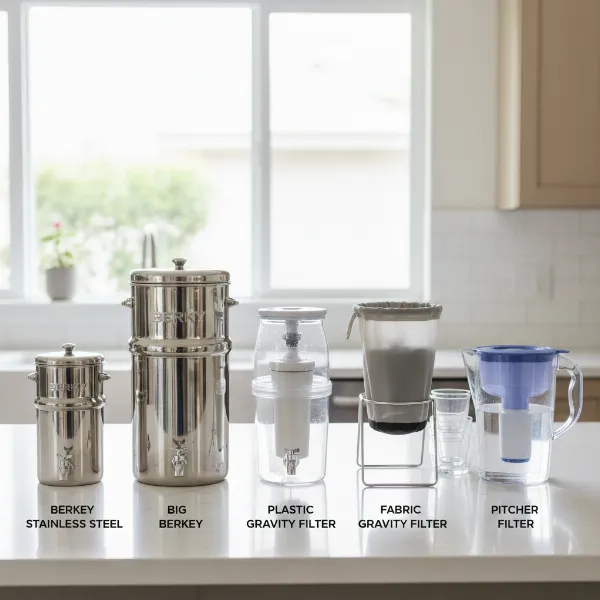 Various Berkey Water Filter models side-by-side with other gravity filters and pitcher filters for comparison
Buying Guide: What to Consider Before Investing in a Berkey
Choosing the right Berkey system, or any water filter, involves several key considerations:
- Your Water Source:
- Municipal Tap Water: If you have municipal water, focus on removal of chlorine, chloramines, disinfection byproducts, lead, and common urban pollutants.
- Well Water/Untreated Sources: For well water or emergency use with untreated sources, prioritize strong pathogen (bacteria, virus, cyst) removal, which Berkey excels at. Consider pre-filtration for heavily turbid water.
- Household Size and Water Consumption:
- 1-2 People: A Travel Berkey might suffice for drinking water.
- 2-4 People: A Big Berkey is a popular and practical choice.
- Larger Families/Groups: Royal, Imperial, or Crown Berkey systems offer greater capacity to reduce frequent refilling.
- Budget: While the initial cost is higher, calculate the long-term cost per gallon, considering filter lifespan. Berkey often proves more economical over years compared to systems with frequent, costly filter changes.
- Portability Needs: If you need a system for camping, RVing, or emergency preparedness that can be easily moved, Berkey’s self-contained design is a significant advantage.
- Specific Contaminant Concerns: If you have particular concerns like fluoride, ensure you account for the additional PF-2 filters. Be mindful of their performance variations as noted in independent tests.
- Genuine Filters: Always purchase genuine Black Berkey purification elements and PF-2 filters from authorized dealers to ensure performance and warranty coverage.
By carefully evaluating these factors, you can select the Berkey model that best aligns with your needs and expectations.
How to Use and Maintain Your Berkey Water Filter
Proper installation, usage, and maintenance are key to maximizing your Berkey’s performance and lifespan.
Installation and First Use:
- Assembly: Assemble the stainless steel chambers and spigot according to the instructions.
- Filter Priming: This is a crucial step. Black Berkey elements must be primed to saturate the filter media, allowing water to flow properly. Use the provided priming button on a faucet or a dedicated priming pump. Water should bead on the outside of the filter and stream from the threaded stem.
- Initial Flush: After assembly and priming, fill the upper chamber with water and allow it to filter through completely. Discard this first batch of filtered water to flush out any manufacturing residues. For systems with PF-2 filters, it’s often recommended to flush two full batches.
Regular Usage:
- Fill the Upper Chamber: Pour raw water into the upper chamber. The water will slowly filter down into the lower chamber.
- Monitor Water Levels: Keep an eye on the water level in the lower chamber to avoid running out, especially with slower filtration rates.
- Cleaning: The stainless steel chambers can be cleaned with mild soap and water. Avoid abrasive cleaners that could scratch the surface.
Filter Maintenance and Replacement:
- Cleaning Black Berkey Elements: If the flow rate slows significantly, the Black Berkey elements may be clogged with sediment. Remove them and scrub the exterior gently with a stiff brush or Scotch-Brite pad under running water. This can often restore flow rate.
- Red Food Dye Test: Periodically, you can perform a red food coloring test (using only red dye, as other colors can stain the filters) to check the integrity of your Black Berkey filters. If any red dye passes through, it indicates the filters need replacement.
- Filter Lifespan: Black Berkey elements typically last for 6,000 gallons per set (or 3,000 gallons per individual filter). PF-2 fluoride filters usually last for 1,000 gallons per set. Track your usage to know when replacements are due.
- Storage: If storing your Berkey for an extended period, ensure filters are completely dry to prevent mold or bacterial growth. Follow specific instructions for long-term filter storage.
Consistent maintenance ensures your Berkey system continues to provide high-quality filtered water efficiently.
Smart Tips for Maximizing Your Berkey’s Lifespan and Performance
Getting the most out of your Berkey water filter involves a few best practices that can extend its life and ensure peak performance.
- Pre-Filter Heavily Contaminated Water: If you’re using a highly turbid or sediment-laden water source (like river water), consider pre-filtering it with a cloth or coffee filter before adding it to your Berkey. This prevents premature clogging of the Black Berkey elements and preserves their lifespan.
- Regular Cleaning of Chambers: Even if your filters are working well, periodically clean the stainless steel chambers to prevent residue buildup and maintain hygiene. A mild dish soap and water solution is generally sufficient.
- Gentle Filter Scrubbing: When flow slows, a gentle scrubbing of the Black Berkey elements with a Scotch-Brite pad under running water can remove accumulated particles and restore flow. Avoid harsh chemicals.
- Proper Priming: Always ensure your filters are properly primed, especially after cleaning or long-term storage. An inadequately primed filter will significantly reduce flow rate and effectiveness.
- Avoid Extreme Temperatures: Do not expose your Berkey system or filters to freezing temperatures, as this can damage the filter media and crack the stainless steel.
- Track Filter Usage: Keep a log or mark your calendar to track when your filters were installed and when they are due for replacement, based on estimated gallons filtered or time passed. This ensures you’re always purifying with effective filters.
Following these tips will help you enjoy clean, safe water from your Berkey system for many years.
“A Berkey filter represents an investment in water independence and health. While the upfront cost may seem high, its longevity and off-grid capabilities offer unparalleled value, especially when traditional infrastructure is compromised.” – Dr. Alistair Finch, Environmental Health Specialist
Conclusion
The Berkey water filter system continues to hold a significant place in the world of water purification, particularly for those seeking a reliable, gravity-fed solution. Its stainless steel construction, independence from electricity, and impressive contaminant reduction capabilities make it a strong contender for daily use and emergency preparedness alike. While discussions around rigorous independent certifications and the performance of optional fluoride filters exist, the core Black Berkey elements consistently demonstrate a high level of filtration effectiveness against a wide range of common waterborne threats.
When stacked against the competition, Berkey often shines in its blend of durability, filter longevity, and the peace of mind it offers in diverse situations. Though it comes with a higher initial price tag and a slower filtration rate than some alternatives, its low long-term cost and ability to preserve beneficial minerals underscore its value. For those prioritizing comprehensive purification, off-grid functionality, and long-term savings, the Berkey remains a compelling choice. Is it still the best gravity system? For many, its proven performance and robust design certainly keep it at the forefront. What are your primary water concerns, and how might a Berkey address them in your home?
Frequently Asked Questions
How often should Berkey filters be replaced?
Black Berkey purification elements are designed to last for up to 6,000 gallons per set (3,000 gallons per individual filter). The frequency of replacement depends on your water consumption, but for an average family, this typically translates to several years. PF-2 fluoride and arsenic reduction filters have a shorter lifespan, usually around 1,000 gallons per set, or about one year of use.
Does the Berkey filter remove beneficial minerals?
No, Berkey filters are designed to be micro-filtration systems that reduce harmful contaminants while allowing beneficial minerals to pass through. This is one of the key advantages of a Berkey system, contributing to healthier and better-tasting water compared to methods that demineralize water.
Can Berkey filters remove viruses?
Yes, the Black Berkey purification elements are engineered to remove pathogenic bacteria, cysts, and viruses to extremely high levels, often exceeding typical industry standards for water purifiers. They are effective against both biological and chemical contaminants, making them suitable for treating various water sources.
Is the Berkey water filter NSF certified?
Berkey Water Filters are not NSF/ANSI certified as a complete system. While Berkey publishes extensive independent lab testing data on the performance of its Black Berkey elements against specific contaminants, the company chooses not to pursue the full system certification. This is a common point of discussion among consumers and reviewers.
What causes a slow Berkey filtration rate, and how can I fix it?
A slow filtration rate is typically caused by clogged filter pores, especially if your source water has high sediment or turbidity. To fix this, remove the Black Berkey elements and gently scrub their exterior with a Scotch-Brite pad under running water to clear accumulated particles. Re-priming the filters may also be necessary if they have dried out or were not adequately primed initially.