Hey there, let’s talk about water. We drink it, cook with it, and bathe in it. We know it’s essential, but have you ever stopped to wonder what’s really coming out of your tap? It’s a question that can send you down a rabbit hole of confusing terms and high-tech gadgets. When you start looking into water filters, the big debate you’ll inevitably encounter is Activated Carbon Vs Reverse Osmosis. It can feel like choosing between two different languages. But don’t worry, that’s why I’m here. We’re going to demystify these two water purification giants, break down what they do, and help you figure out which champion is right for your home. Ready to dive in?
First, What Are We Even Fighting? Understanding Tap Water Contaminants
Before we can pick a winner, we need to know the opponents. Your tap water, even if it’s considered “safe” by municipal standards, can carry a whole host of unwanted guests. It’s like a party you never wanted to host. The U.S. Environmental Protection Agency (EPA) regulates over 90 different contaminants, but many more can find their way into your water supply.
Here’s a quick rundown of the usual suspects:
- Chlorine: Used by water treatment plants to disinfect, but it can leave an unpleasant taste and smell, reminiscent of a swimming pool.
- Heavy Metals: Think lead from old pipes, mercury, or arsenic. These are serious health concerns and definitely not on the guest list.
- VOCs (Volatile Organic Compounds): These are chemicals from things like pesticides, herbicides, and industrial solvents.
- PFOA & PFAS: Often called “forever chemicals,” these are widespread industrial contaminants that are notoriously difficult to remove.
- Total Dissolved Solids (TDS): This is a broad category for any minerals, salts, or metals dissolved in water. This includes harmless minerals like calcium and magnesium, but also harmful ones.
- Microorganisms: Bacteria, viruses, and cysts. While municipal treatment usually handles these, boil-water advisories happen for a reason.
Now that we know the lineup of potential intruders, let’s meet our two main contenders for keeping them out.
Meet the Contender: Activated Carbon, The Great Adsorber
Think of activated carbon as a highly effective bouncer with a very sticky coat. It’s not just charcoal; it’s carbon that has been treated with oxygen to open up millions of tiny pores between its atoms. This process dramatically increases its surface area.
How Does Activated Carbon Work?
The magic word here is adsorption (with a “d,” not a “b”). While absorption is like a sponge soaking up water, adsorption is when contaminants physically stick to the outside surface of the carbon. As water passes through the filter, the unwanted chemicals and impurities get trapped on the massive surface area of the activated carbon.
It’s like running a thousand tiny magnets through your water that only attract the bad stuff, like chlorine, VOCs, and chemicals that cause bad tastes and odors.
What Activated Carbon Is Great At
- Improving Taste and Odor: This is its number one job. It excels at removing chlorine and other chemicals that make your water taste or smell funky.
- Removing Certain Chemicals: It’s very effective against many common organic compounds and pesticides.
- Cost-Effective: Activated carbon filters are generally more affordable, found in everything from water pitchers to faucet-mounted systems.
Where It Falls Short
- Doesn’t Remove Dissolved Solids: It won’t touch most heavy metals, fluoride, or nitrates. Healthy minerals like calcium and magnesium will also pass right through.
- Limited against Microorganisms: It’s not designed to reliably remove bacteria or viruses.
- Inconsistent on Lead: While some specialized carbon block filters (a denser form of activated carbon) are certified to reduce lead, standard granular activated carbon (GAC) is less effective.
Meet the Other Contender: Reverse Osmosis, The Meticulous Purifier
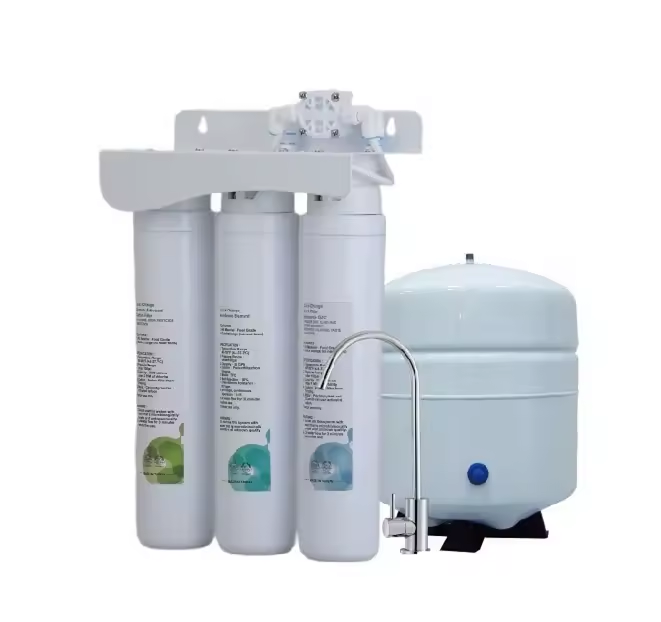
If activated carbon is a bouncer, reverse osmosis (RO) is a top-level security system with a near-impenetrable gate. It uses a semipermeable membrane—a material with microscopic pores so small that almost nothing but pure water molecules can get through.
How Does Reverse Osmosis Work?
Your home’s water pressure is used to force water through this special membrane. It’s a bit like pushing grape juice through a coffee filter so fine that only the clear water part gets through, leaving all the sugar, color, and pulp behind.
The RO membrane acts as a barrier to an incredible range of contaminants, which are then flushed away in a stream of wastewater. What comes out the other side is incredibly pure H2O.
“Reverse osmosis is the gold standard for removing the widest possible spectrum of contaminants. From heavy metals like lead to dissolved salts and even viruses, the physical barrier of the RO membrane is incredibly effective. It’s less about targeting specific chemicals and more about a brute-force approach to purification.” – Dr. Eleanor Vance, Water Quality Specialist
What Reverse Osmosis Excels At
- Broad-Spectrum Removal: RO systems remove an impressive list of contaminants—up to 99%+ of total dissolved solids. This includes heavy metals, fluoride, nitrates, sulfates, bacteria, and viruses.
- Ultimate Purity: If your goal is the purest possible drinking water, reverse osmosis is the undisputed champion.
- Tackles “Forever Chemicals”: It is one of the most effective methods for removing difficult contaminants like PFOA and PFAS.
The Downsides to Consider
- Wastewater: The purification process creates wastewater (called brine) that flushes the rejected contaminants down the drain. Modern systems are much more efficient, but it’s still a factor.
- Slower Process: It takes time to force water through the membrane, so RO systems typically use a storage tank to hold purified water for on-demand use.
- Removes Healthy Minerals: The membrane is so fine it doesn’t distinguish between bad contaminants and beneficial minerals like calcium and magnesium. Some systems include a remineralization stage to add these back in.
- Higher Cost and Maintenance: RO systems are a more significant investment upfront and require periodic filter and membrane replacements.
The Head-to-Head Battle: Activated Carbon vs Reverse Osmosis
So, how do they stack up side-by-side? It’s not about which one is “better” overall, but which one is better for your specific needs.
| Feature | Activated Carbon | Reverse Osmosis |
|---|---|---|
| Primary Function | Improves taste & odor, removes chlorine, VOCs | Removes a vast range of contaminants (99%+) |
| Contaminant Removal | Selective (chlorine, pesticides, some chemicals) | Comprehensive (heavy metals, TDS, fluoride, bacteria) |
| Mineral Retention | Keeps healthy minerals (calcium, magnesium) | Removes all minerals (good and bad) |
| Water Waste | None | Produces wastewater (brine) |
| Installation | Simple (pitchers, faucet mounts) to moderate | More complex (typically under-sink) |
| Upfront Cost | Low to moderate | Moderate to high |
| Maintenance | Regular, simple filter changes (e.g., every 2-6 months) | Multi-stage filter changes + membrane replacement (every 1-3 years) |
The crucial takeaway: Most reverse osmosis systems also include activated carbon filters. They work as a team! The carbon filters act as pre-filters to protect the delicate RO membrane from chlorine and as post-filters to give the water a final “polish” for taste. So, the choice often isn’t one or the other, but whether you need the added power of the RO membrane.
How Do I Choose The Winner For My Home?
Making the right choice comes down to answering a few key questions.
- What’s in my water?
This is the most important step. You can’t solve a problem if you don’t know what it is. Look up your local water quality report (often called a Consumer Confidence Report or CCR) from your utility provider. For a more precise picture, consider getting an independent home water test. If your main issue is just the taste of chlorine, an activated carbon filter might be all you need. If the report shows high levels of lead, arsenic, or TDS, a reverse osmosis system is a much safer bet. - What is my main goal?
Are you simply looking for better-tasting water for your coffee and tea? A quality activated carbon pitcher or faucet filter will do the trick. Are you concerned about specific health risks, have a compromised immune system, or simply want the peace of mind that comes with the purest possible water? Then an RO system is your answer. - What is my budget and maintenance tolerance?
Be realistic about your budget for the initial purchase and ongoing filter replacements. Activated carbon is the budget-friendly choice. Reverse osmosis is an investment in your home’s infrastructure and your family’s health, with higher long-term costs. - Where do I need filtered water?
Do you only need it for drinking and cooking? An under-sink RO system or a countertop carbon filter is perfect. If you want filtered water at every tap in the house, you’d be looking at a whole-house activated carbon system.
Frequently Asked Questions (FAQ)
Can I use both activated carbon and reverse osmosis together?
Absolutely! In fact, the best reverse osmosis systems are multi-stage units that use activated carbon as both a pre-filter and a post-filter. The carbon protects the RO membrane and improves the final taste of the water.
Does reverse osmosis water taste different?
Yes, it can. Because it removes virtually everything, some people describe RO water as “flat” or “empty.” This is due to the lack of minerals. Many people prefer this clean taste, while others opt for an RO system with a remineralization filter that adds back healthy minerals to improve the taste.
How often do I need to change my water filters?
This depends entirely on the system and your water usage. For activated carbon filters in pitchers, it’s typically every 1-2 months. For under-sink systems, carbon filters might last 6-12 months. For a reverse osmosis system, the pre- and post-filters are usually changed annually, while the RO membrane itself can last 2-4 years.
Is reverse osmosis wasteful?
Historically, RO systems had a high water-waste ratio. However, modern systems have become much more efficient, with some having a waste-to-pure-water ratio as low as 1:1. While it does use more water than a simple carbon filter, it’s a trade-off for unparalleled purification.
Which is better for well water?
For well water, a reverse osmosis system is almost always the recommended choice. Well water is not municipally treated and can contain a wider and more unpredictable range of contaminants, including nitrates, heavy metals, and bacteria, which RO is specifically designed to handle.
The Final Verdict
So, in the great activated carbon vs reverse osmosis debate, there’s no single knockout punch. The winner is the one that best fits your water quality, your health goals, and your lifestyle.
Activated carbon is the nimble, targeted solution for making good water taste great. It’s accessible, affordable, and effective at tackling common aesthetic issues like chlorine. Reverse osmosis is the heavyweight champion of purification, providing a comprehensive defense against the broadest range of contaminants. It’s an investment in ultimate peace of mind.
The first step is knowledge. Find out what’s in your water, and you’ll have all the information you need to choose the right guardian for your family’s health and hydration.